Economics
Finance
Policy
Technology
AMI, AMISP, AT&C Losses, Behavioural Regulation, Consumer Protection, DISCOM, Distribution Sector, Electricity Act 2003, Energy Infrastructure, Energy Regulation, Energy Transition India, Federal Regulation, GSOP, India Energy Policy, Institutional Reform, Ministry of Power, Ofgem, PFC, Policy Analysis, Power Sector Reform, Prepaid Meters, RDSS, REC, Regulatory Accountability, Rights of Consumers Rules 2020, SERC, Smart Metering, UK Energy Policy, Wired to Fail
AnilMehta
India’s Consumers Got the Promise. Britain’s Got the Money !
Why India’s smart metering consumer promise remains undeliverable — and what would actually fix it. Both the UK’s apparent success and India’s apparent failure are more complicated than the headline comparison suggests.
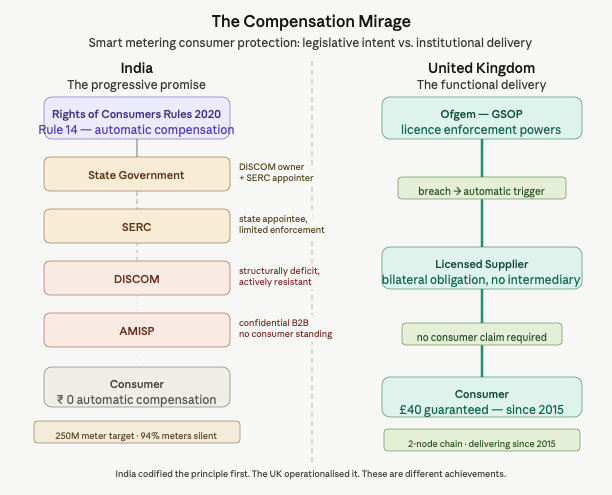
Lets start with an inconvenient fact about Britain. The Ofgem document that prompted this comparison is a £10 inflation adjustment to a compensation quantum that has existed since 2015. What it does not mention is that the UK’s own smart meter rollout — originally mandated to reach 53 million homes by 2020 — missed its target by years, burned through cost overruns, and produced the SMETS1 debacle: an entire generation of first-specification smart meters that went dumb the moment a consumer switched suppliers, because interoperability had not been solved before deployment was mandated. The UK’s GSOP consumer protection framework functions well precisely because it predates smart metering — it was built for conventional supplier obligations and applied to the new technology. The consumer protection infrastructure was not designed alongside the metering rollout. It was already there.
India has no such inheritance. It is attempting to build the consumer protection architecture and the metering infrastructure simultaneously, at ten times the scale, across a federal structure in which the entity with legislative authority over consumer rights has no direct power over the entity responsible for delivering them. That is not an excuse for the current state of affairs. It is the correct framing for understanding why generic prescriptions — “implement automatic compensation,” “enforce SLA pass-throughs” — fail to engage with the actual problem.
Why the UK comparison flatters the wrong lesson
Britain’s regulatory simplicity is often mistaken for regulatory sophistication. Ofgem regulates approximately thirty licensed energy suppliers. Each holds a single national licence. The accountability chain for a consumer protection breach runs: supplier breaches standard → automatic compensation triggered → Ofgem monitors aggregate compliance → licence consequences for persistent failure. There are no intermediate tiers. There is no federal structure. There is no state government that is simultaneously the majority shareholder of the entity being regulated and the appointing authority for the regulator overseeing it.
The GSOP works in the UK not because British institutions are smarter but because British institutional design did not create the conditions for accountability to dissolve before it reaches the consumer. Importing the mechanism without replicating the structural conditions that make it enforceable is not policy transfer. It is decoration.
India’s federal problem is not a bug — it is load-bearing
The Electricity (Rights of Consumers) Rules 2020 is a well-drafted instrument. Rule 14’s automatic compensation mandate for remotely monitorable parameters reflects genuine understanding of what smart metering makes technically possible. The Ministry of Power’s drafters were not naive. They knew that SERCs would need to transpose, and that DISCOMs would need to implement. What the Rules could not solve — because no central instrument can — is that in most states, the DISCOM is a state government entity operating at a structural deficit, the SERC is staffed by appointees of the same state government, and automatic compensation represents a direct hit to a balance sheet that is already negative.
Maharashtra’s DISCOMs carry combined losses running into thousands of crores. Uttar Pradesh’s distribution utilities have been restructured multiple times without resolving their fundamental insolvency. Bihar’s DISCOM, despite being the site of one of India’s most ambitious smart metering deployments, operates in a state where agricultural and below-poverty-line consumers receive heavily subsidised or free power — a political commitment that makes any mechanism that increases utility costs politically radioactive. Telling these entities to implement automatic compensation is not a regulatory instruction. It is a request to voluntarily accelerate their own financial deterioration. The Punjab case — where PSPCL ignored a PSERC notification for months without consequence — is not an outlier. It is the equilibrium.
This is before accounting for the communication failure that renders the entire automatic mechanism theoretical. If 94% of installed meters are not transmitting data, the remote monitorability condition that triggers automatic compensation is not met. The consumer protection framework is logically dependent on infrastructure that does not yet function at scale. Sequencing matters, and it has been ignored.
What would actually work
The first honest acknowledgment is that automatic compensation cannot be the first instrument deployed. It must be the last — the output of a functioning system, not a lever to create one. The sequencing imperative that applies to climate institutions applies here with equal force: you cannot rewire behaviour through incentives that the institutional architecture prevents from being felt.
With that constraint accepted, three interventions are both structurally sound and politically navigable.
The first is to make RDSS fund disbursement conditional on demonstrated consumer protection implementation, not meter installation count. PFC and REC currently disburse funds against physical deployment milestones. Communicating meters, not installed meters, should be the metric — with a SERC-certified automatic compensation framework as a prerequisite for tranches beyond the initial deployment phase. This converts a central funding lever into an enforcement mechanism without requiring direct central override of state regulatory authority. States that want RDSS money will need to build the infrastructure that makes consumer protection real.
The second is to make the AMISP’s liability to the consumer explicit in the Standard Bidding Document, not buried in B2B contract schedules that are confidential and unenforceable by the people they affect. The consumer does not have standing to enforce an AMISP’s contractual obligations to the DISCOM. This can be changed by inserting a direct consumer-facing SLA into the bidding conditions — specifying that a non-communicating meter beyond a defined threshold triggers a compensation obligation that runs from AMISP to DISCOM to consumer as a single chain, with the DISCOM holding the AMISP liable on a back-to-back basis. This does not require new legislation. It requires a revision to MoP’s model SBD, which is within central government’s authority.
The third is a Forum of Regulators-mandated annual scorecard that publicly ranks each SERC on consumer protection implementation — compensation framework notified, DISCOMs in compliance, compensation amounts paid against breaches detected. Publication is not enforcement, but regulatory peer pressure within a federal structure has been underused as a tool. States are sensitive to comparative rankings in ways they are not sensitive to central directives.
What right implementation would do to the rollout
The case for building consumer protection infrastructure properly is not humanitarian — or not only humanitarian. It is operational. The reason smart meter adoption is running at 1.6% prepaid penetration despite years of deployment is not primarily technical. It is trust. Consumers in Bihar, Rajasthan, and Uttar Pradesh who have seen meters installed and then disconnected remotely for disputed balance readings, with no recourse and no automatic redress, are not irrational to resist prepaid migration. A functioning automatic compensation mechanism — even a partial one, even limited to supply interruption duration and meter communication failures — creates the conditions in which consumers have a reason to accept the technology rather than resist it.
There is also a second-order effect that is consistently underestimated. If DISCOMs face automatic compensation liability for non-communicating meters, their incentive to enforce AMISP SLAs changes immediately. The current equilibrium — in which DISCOMs lack both the technical capacity and the financial motivation to hold AMISPs accountable — shifts when the DISCOM’s own balance sheet is directly exposed to communication failures. Consumer protection and operational performance are not separate agendas. They are the same problem approached from opposite ends.
The UK’s GSOP is not a model to copy. It is a destination that took Britain two decades to reach, built on a regulatory structure India does not have and cannot simply construct. The useful question is not how to replicate it but what minimum viable version of its core principle — automatic, non-discretionary accountability for verifiable service failure — can be made to function within India’s actual institutional architecture. That question has an answer. It requires sequencing, conditional financing, SBD reform, and public accountability mechanisms. It does not require waiting for India’s federal structure to resolve its contradictions. Those contradictions are permanent features, not temporary obstacles. Policy design that treats them as the latter will keep producing rules that look progressive and deliver nothing.
References –
https://www.ofgem.gov.uk/decision/supplier-guaranteed-standards-performance-gsop-payment-uplift
https://powermin.gov.in/sites/default/files/uploads/Orders/A.1.1.pdf