Economics
Environment
Finance
Policy
Antalya, Behavioral Economics, Carbon Footprint, Climate Change, COP31, Ecocide, Energy Transition, Environmental Impact, Financial Times, Finite Pool of Worry, geopolitics, Global Conflict, Green Reconstruction., ICJ Ruling, Military Emissions, Peace and Security, Scarcity Mindset, Sustainability, Ukraine War, West Asia
AnilMehta
The $2.7 Trillion Blind Spot: How War is Killing the Climate
The global strategic landscape in 2026 is defined by an unprecedented convergence of existential threats that have fundamentally altered the psychological and economic frameworks of international cooperation. As the world navigates the highest level of active state-based conflicts since the end of the Second World War, the discourse surrounding the climate crisis has undergone a significant transformation. The transition from long-term sustainability goals to an immediate survival imperative is not merely a political shift but a deep-seated behavioural response to systemic instability. With 59 active conflicts involving 78 countries in extra-territorial military engagements, the cognitive resources of global leaders and the public are increasingly consumed by the “finite pool of worry,” a behavioural phenomenon where immediate threats displace long-term risks. This report analyses the behavioural economics of this transition, the hidden environmental costs of modern warfare, and the legal and institutional challenges facing the upcoming 31st Conference of the Parties (COP31) in Antalya, Turkey.
The Psychology of the Survival Imperative
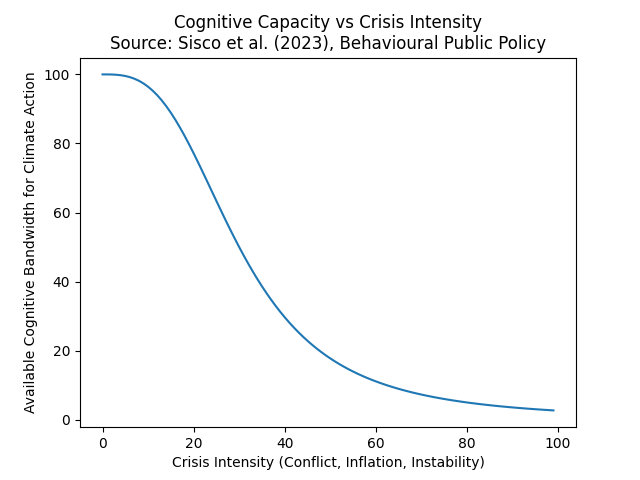
The shift in global priorities can be traced to the behavioural mechanisms of “tunneling” and the “scarcity mindset.” Behavioural economics suggests that when individuals or societies perceive an immediate threat to their survival—whether through armed conflict or economic volatility—their cognitive capacity for long-term planning is significantly diminished. This “tunneling” effect forces a laser-focus on the immediate crisis, effectively marginalizing the “creeping” threat of climate change, which often lacks the visceral, sensory immediacy of a kinetic conflict. The psychological weight of this scarcity, particularly in the 78 nations engaged in wars beyond their borders, creates a cognitive “IQ drop” that hampers the ability to process complex scientific data and implement the sophisticated policy trade-offs required for the energy transition.
The Finite Pool of Worry and Risk Perception
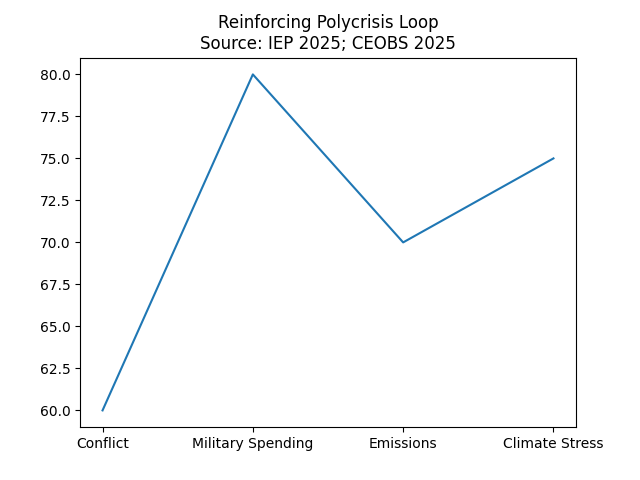
The “finite pool of worry” hypothesis posits that concern for one major threat, such as a pandemic or a widening regional war, often causes a corresponding decrease in concern for other issues like environmental degradation. Longitudinal studies from Norway and other regions during multiple crises indicate that while climate anxiety remains high among younger populations, the general public often experiences a “displacement” of environmental concern when faced with immediate health or security threats. However, this relationship is non-linear; in some instances, such as the current conflict in Ukraine, the experience of a critical life-altering crisis has been shown to amplify awareness of interconnected global risks, a process known as “affect generalization”. This suggests that while cognitive bandwidth is strained, the visceral experience of vulnerability can occasionally catalyze a broader understanding of systemic fragility.
| Behavioural Mechanism | Psychological Definition | Impact on Climate and Conflict Discourse |
| Finite Pool of Worry | The theory that concern for one major threat reduces worry for others. | Active conflict in the Middle East and Europe displaces long-term climate attention. |
| Tunneling | Intense cognitive focus on immediate resource scarcity or threat. | Policy focus shifts toward military rearmament and energy security over decarbonization. |
| Present Bias | The tendency to over-value immediate rewards over future benefits. | Postponing capital-intensive green investments in favor of immediate fossil fuel subsidies. |
| Affect Generalization | The process where worry about one threat spills over into others. | Increased awareness of global fragility in high-conflict zones like Ukraine. |
| Terror Management | Defensive strategies (e.g., consumerism) used when mortality is salient. | High-conflict environments may inadvertently trigger carbon-intensive “defensive” consumption. |
The phenomenon of “mortality salience” is particularly relevant in 2026. Research in terror management theory indicates that discourse surrounding existential threats like war or climate catastrophe often prompts individuals to adopt psychologically defensive strategies, such as increased consumerism or a retreat into nationalist identities, both of which are counterproductive to collective climate action. This behavioural “rebound” complicates the political economy of the energy transition, as the very crises that demand cooperation often trigger the instinct for isolation and resource competition.
The Environmental Footprint of Modern Warfare
The 59 active conflicts recorded in 2025 represent more than just a humanitarian catastrophe; they are a primary driver of global greenhouse gas emissions that remain largely invisible in international accounting. 1 Global militaries and their supporting industries are estimated to account for 5.5% of total greenhouse gas emissions. 2 If the world’s armed forces were a single nation, they would rank as the fourth-largest emitter on the planet, producing more carbon annually than Russia and trailing only China, the United States, and India. 3
The Reporting Loophole and the Military Emissions Gap
A significant challenge in addressing the climate impact of conflict is the lack of mandatory reporting for military emissions. This “loophole” was carved out during the 1997 Kyoto Protocol and maintained in the 2015 Paris Agreement, primarily at the insistence of the United States and other major military powers. Consequently, emissions from fuel-hungry tanks, aircraft, and the massive supply chains required for the arms industry are frequently categorized under civilian sectors like “aviation” or “industry,” or omitted entirely. Recent data reveals that the gap between what countries report to the UNFCCC and their actual military emissions is widening, undermining the integrity of global stocktakes.
| Conflict Area | Estimated Emissions (MtCO2e) | Equivalent Comparison |
| Global Military Sector | 2,750.0 (Annual) | 4th largest global emitter. |
| Israel-Gaza War (15 months) | 33.2 | Annual emissions of Jordan or 7.6 million petrol cars. |
| Russia-Ukraine War (3 years) | 230.0 – 294.0 | Exceeding the annual emissions of 175 individual countries. |
| NATO 2% GDP Spending Goal | 467.0 (Additional by 2028) | Cumulative total that could fulfill climate finance gaps. |
| US Department of Defense | ~750.0 (Annual) | Largest institutional consumer of petroleum globally. |
| Peacekeeping Operations | 41.6% of UN System | High operational footprint in fragile states. |
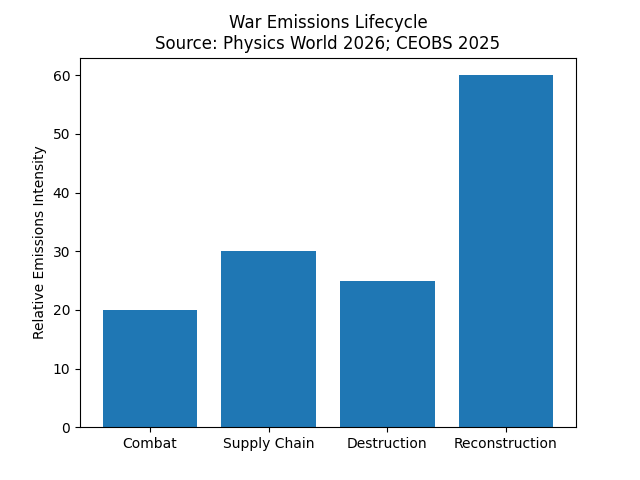
The “double emission” cycle of war is particularly catastrophic. Carbon is emitted first to destroy civil infrastructure and then emitted again—often at a much higher intensity—to rebuild it using carbon-intensive materials like cement and steel. In Ukraine, the 10-year reconstruction effort is projected to generate 741 to 781 million tonnes of , which is approximately 4.3 times the country’s pre-war annual emissions. Similarly, the rebuilding of Gaza is estimated to produce 31.4 million tonnes of emissions, an amount greater than the annual carbon output of Portugal or Sweden.
Toxic Legacies and Ecosystem Destruction
The environmental cost of conflict extends beyond carbon to the “ecocide” of critical carbon sinks. In the Middle East and Eastern Europe, the targeting of oil refineries, chemical depots, and nuclear facilities has released toxic plumes of heavy metals, sulfur compounds, and carcinogenic particulates into the atmosphere. Airstrikes on Iranian oil warehouses in early 2026 resulted in thick black smoke that contaminated air and soil, while the destruction of 80% of Gaza’s trees has devastated local biodiversity and disrupted international bird migration corridors. In the Gulf, naval skirmishes and the sinking of vessels threaten fragile marine ecosystems already stressed by rising temperatures.
Furthermore, the rerouting of civilian air traffic and global shipping lanes due to conflict zones adds a significant “invisible” carbon cost. Disruption of the Suez Canal can increase the carbon footprint of ships by nearly 50% as they navigate around the Cape of Good Hope, while the closure of Russian airspace has increased global aviation emissions by approximately 1% due to longer flight paths. These systemic inefficiencies represent a massive setback for global decarbonization efforts, particularly as military budgets balloon at the expense of green transition funding.
Geopolitical Fragmentation and the Failure of Diplomacy
The 2025 Global Peace Index paints a grim picture of international stability, with global peacefulness declining for the 13th consecutive year. The “internationalisation” of intrastate conflicts has reached a fever pitch, with 78 countries now engaged in wars beyond their borders, often as proxy actors in middle-power rivalries. This fragmentation has led to a collapse in traditional conflict resolution mechanisms.
The Reversal of the Peace Dividend
The “peace dividend” that followed the Cold War has effectively vanished. Global military spending reached a record US$2.7 trillion in 2024, representing 11.6% of gross world product when accounting for the full economic impact of violence. This escalation occurs at a time when the successful resolution of conflicts is lower than at any point in the last 50 years. Conflicts ending in a decisive military victory have fallen from 49% in the 1970s to just 9% in the 2010s, while peace agreements have plummeted from 23% to 4%.
| Conflict Resolution Indicator | 1970s Baseline | 2025 Status |
| Conflicts Ending in Decisive Victory | 49% | 9%. |
| Conflicts Ending in Peace Agreements | 23% | 4%. |
| Number of Active State-Based Conflicts | 30-40 (avg) | 59. |
| Countries Involved in Extra-territorial War | 6 (1970s) | 78. |
| Economic Impact of Violence (Annual) | – | $19.97 Trillion (PPP). |
This persistent state of “low-level” but “long-duration” conflict creates a permanent drain on both financial and cognitive resources. The $19.97 trillion lost to violence could fulfill the developed world’s climate finance commitments many times over. Instead, the world is locked in an escalating arms race where every dollar spent on the military generates twice the greenhouse gas emissions of a dollar spent in the civilian sector.
The Legal Inflection Point: The ICJ Ruling of July 2025
Amidst this geopolitical turmoil, the International Court of Justice (ICJ) delivered a landmark Advisory Opinion on July 23, 2025, that has fundamentally shifted the legal landscape of climate accountability. The Court unanimously ruled that states have comprehensive, binding obligations under multiple sources of international law to protect the climate system. This ruling clarified that climate action is not a matter of political choice but a legal duty, grounded in the obligation to prevent significant environmental harm to other states.
Implications for Military and Private Sector Accountability
While the ICJ opinion did not directly analyze military emissions in its primary text, it reinforced the “due diligence” obligation of states to regulate all high-emitting activities within their jurisdiction. Judge Cleveland’s independent declaration was more explicit, arguing that states should pay increased attention to armed conflicts and military emissions, and that the destruction of carbon sinks like forests must be factored into jurisdictional responsibility.
This ruling creates several new leverage points for climate litigation and policy:
- Proportionality Tests: Emissions estimates may now be integrated into “proportionality tests” under international humanitarian law, suggesting that military operations causing disproportionate climate harm could be deemed legally wrongful.
- Corporate Accountability: The Court affirmed that states are responsible for failing to regulate the emissions of private actors, including major fossil fuel producers and agro-industrial companies.
- Sovereign Credit Ratings: Research suggests that climate change is increasingly linked to sovereign creditworthiness. The ICJ ruling may accelerate the integration of “climate-adjusted” credit ratings, as states failure to meet legal obligations becomes a material financial risk.
- Reparations for Frontline Nations: The opinion establishes that those suffering from climate devastation have a right to remedy and reparation, potentially opening the door for “climate debt” claims against major historical emitters.
The Failure of Interdisciplinary Integration in Climate Science
The current crisis reflects a long-standing failure to integrate behavioural science into the core of climate science and policy. Since the late 1970s, behavioural scientists have warned that “the probable outcome [of climate change] is beyond human experience,” yet the field has largely been dominated by physical scientists focused on atmospheric modeling. This disengagement led to a “missed opportunity” where public discourse and policy evolved without a deep understanding of human decision-making, risk perception, and conflict resolution.
The Three Missed Connections
Behavioural science could have contributed to climate action in three critical ways that are now essential for navigating 2026:
- Quantitative Translation: Translating behavioural results into the quantitative estimates that climate and economic analyses need. Traditional economic models often assume “perfect rational actors,” leading to terrible track records in predicting the rollout of renewables or the public response to carbon taxes.
- Decision Relevance: Making climate research more relevant to the actual decisions people face. Instead of simply providing “more information” (the information deficit model), scientists need to understand the “mental models” and conceptual problems that prevent the public from constructings preferences for novel climate trade-offs.
- The Analytical Process as a Behavioural Enterprise: Treating the analytical process itself as subject to subjective judgments and biases. Experts often make conservative estimates or exclude unquantifiable issues (like the social cost of conflict) from their models, creating a distorted picture for decision-makers.
Project 5 of the 1980s behavioural agenda specifically called for “anticipating and clarifying conflicts created by the inequitable effects of -induced climate change”. The failure to fund and prioritize this research has left the global community ill-equipped to resolve the “commons dilemmas” that have now escalated into the 59 active conflicts defining the modern era.
Complexity Economics and the Energy Transition
As the world approaches 2027, the limitations of neoclassical economic models have become glaringly apparent. These models, which assume equilibrium and rational agents, have consistently failed to account for the non-linear, disruptive nature of the energy transition. New “complexity economics” models are emerging that individually represent 30,000 companies and their assets (oil rigs, power stations), simulating realistic decision-making based on trial-and-error rather than perfect foresight.
Feedback Loops and Non-Linear Change
Understanding the “causal feedback loops” in the global energy system is essential for policy design. These include “reinforcing feedbacks” that can amplify the transition (e.g., the plummeting cost of solar and EVs) and “dampening feedbacks” that preserve the stability of the fossil fuel regime.
- Price Elasticity: Residential electricity demand remains highly price-inelastic in the short term, meaning environmental taxes alone are often insufficient to change behavior without near-perfect low-carbon alternatives.
- The “Green Premium”: Innovation must focus on reducing the price gap between clean technology and fossil fuels. Investors are increasingly focusing on “high-impact” technologies that can eventually have a “zero green premium,” making sustainable choices the default economic option.
- Labor Market Disruption: The transition is reshaping global labor markets, with transition risks concentrated in advanced economies reliant on pollution-intensive industries, and physical risks (heat-exposed productivity loss) concentrated in Africa and Asia.
Media Trends and the Crisis of Attention
The responsibility for keeping climate change visible increasingly falls on the news media, yet the media environment itself is under profound pressure. Since 2022, trust in politicians has remained low (23%), while trust in scientists has grown to 71%. However, the audience for “hard news” is being squeezed by two forces: “answer engines” (AI search) that reduce traffic to news sites and a shift toward personality-led news on platforms like TikTok and YouTube.
The Decline of the Climate Beat
Despite increasing reader interest, climate-related coverage fell by 14% globally in 2025 and is down 38% from its peak in 2021. In the United States, major networks like ABC, CBS, and NBC reduced climate coverage by 35% in a single year, focusing instead on the 2024 election and subsequent international conflicts. This “newsroom boredom” and the “firehose of other news” (war, immigration, authoritarianism) have pushed climate off the agenda precisely when it is most urgent.
| Media Trend (2025-2026) | Statistical Indicator | Implications for Climate Action |
| Decline in TV Climate Coverage | -35% on major US networks. | Public awareness of the urgency of the 1.5°C goal is eroding. |
| Trust in Scientists | 71% (Highest institutional trust). | Experts remain the most credible voice for policy change. |
| Trust in News Media | 36% (France) to 72% (Pakistan). | Large regional disparities in how climate “facts” are received. |
| Search Engine Traffic to News | Projected -43% by 2029. | “Zero-click” AI overviews may limit deep engagement with climate reports. |
| Global Peace Index Decline | 87 countries saw a decline in peacefulness. | Geopolitical news dominates the news cycle over scientific updates. |
The Road to COP31: Antalya and the Pacific Voice
COP31, scheduled for November 9–20, 2026, in Antalya, Turkey, represents the next critical milestone for international climate governance. This conference is unique in its “joint presidency” between Turkey and Australia, two nations with vastly different but equally pressing climate and security concerns.
Strategic Priorities for Antalya
The conference will be chaired by Turkey’s Minister of Environment, Murat Kurum, while Australia’s Minister for Climate Change and Energy, Chris Bowen, will preside over negotiations. This partnership aims to bridge the gap between the Global North and the Global South, with a “pre-COP” meeting expected to convene on a Pacific island to highlight the existential threat of rising sea levels to island nations.
Key themes for COP31 include:
- Integrating Climate and Security: Moving climate security from the side events to the formal agenda, particularly the reporting of military emissions and the environmental cost of war.
- Biodiversity and Food Systems: Addressing the “water bankruptcy” of regions like Iran and the impact of conflict on global food security.
- Just Transition in Fragile States: Developing financing mechanisms for green energy transitions in post-conflict zones, ensuring that reconstruction does not lock these nations into fossil fuel dependence.
- The 7th Assessment Cycle: The Intergovernmental Panel on Climate Change (IPCC) will be deep into its 7th cycle of scientific work, with a Leaders’ Summit expected in Istanbul to set the agenda for the 2030s.
Conclusion: Bridging the Gap Between War and Warming
The current global situation in 2026 represents a “polycrisis” where behavioural biases, kinetic conflicts, and ecological collapse are inextricably linked. The shift in discourse toward war and survival is a predictable human response to a world with 59 active conflicts, but it is one that the planet cannot afford. The $19.97 trillion economic cost of violence is a direct “opportunity cost” that prevents the scaling of sustainable industries, which are projected to reach trillions in value by 2035.
To move forward, the international community must embrace a “complexity economics” approach that recognizes the non-linear relationship between peace and the environment. This includes:
- Closing the Military Emissions Gap: Making the reporting of military mandatory in all NDCs and using the ICJ ruling to hold nations accountable for the climate impact of warfare.
- Behavioural Decarbonization: Moving beyond the “information deficit model” to design interventions that address present bias and the cognitive barriers to the green transition.
- Peace as a Climate Prerequisite: Recognizing that climate stability is impossible in a fragmented world where 78 countries are engaged in extra-territorial conflict. The resolution of these “commons dilemmas” is the first and most necessary step toward a 1.5°C future.
As we look toward Antalya and the road beyond 2026, the challenge is one of pace. Without deliberate action to accelerate the transition and resolve the current surge in global violence, the alternative is an “unmanaged decline” marked by escalating crises and threats to the very stability on which our economic systems depend. The “human will and wisdom” cited by the ICJ must now be harnessed at every level—social, political, and individual—to secure a future for those yet to come.
References:
- Institute for Economics & Peace (IEP). (2025). Global Peace Index 2025: Measuring Peace in a Complex World. ( https://www.visionofhumanity.org/wp-content/uploads/2025/06/Global-Peace-Index-2025-web.pdf)
- Conflict and Environment Observatory (CEOBS). (2025). The War On Climate: Closing the Military’s Emissions Gap. (https://cwrrr.org/opinions/the-war-on-climate-closing-the-militarys-emissions-gap/)
- Henzler, C. M. (2020). Mapping Conflict and Protected Areas. (https://thesis.eur.nl/pub/61235/Henzler-Carla-Marie-_MA_2020_21_AFES.pdf )
- Impakter. (2026). War and Environment: Lasting and Irreversible Impacts. (https://impakter.com/war-environment-lasting-impacts/)
- The Sustainable Times. (2026). The Climate Casualty of War: Visible and Invisible Costs. (https://thesustainabletimes.com/the-climate-casualty-of-war/)
- The Hindu. (2026). The Environment: Another Casualty of War in West Asia. (https://www.thehindu.com/sci-tech/energy-and-environment/the-environment-another-casualty-of-war-in-west-asia/article70749549.ece/amp/)
- Queen Mary University of London. (2026). Study Highlights the Hidden Climate Cost of the Israel-Gaza War. (https://www.qmul.ac.uk/media/news/2026/humanities-and-social-sciences/hss/study-highlights-the-hidden-climate-cost-of-the-israelgaza-war.html)
- Physics World. (2026). The Environmental and Climate Cost of War: Rerouting and Reconstruction. (https://physicsworld.com/a/the-environmental-and-climate-cost-of-war/)
- Fischhoff, B. (2021). Making behavioral science integral to climate science and action. (https://www.cambridge.org/core/journals/behavioural-public-policy/article/making-behavioral-science-integral-to-climate-science-and-action/548894558C53E951F9CBA8F898E79FEF)
- Sisco, M. R., et al. (2023). Examining evidence for the Finite Pool of Worry and Attention hypotheses. (https://www.researchgate.net/publication/366768086_Examining_evidence_for_the_Finite_Pool_of_Worry_and_Finite_Pool_of_Attention_hypotheses )
- Gregersen, T., et al. (2022). A Finite Pool of Worry? Climate Change Concern During the COVID-19 Pandemic. (https://oamonitor.ireland.openaire.eu/rfo/sfi_rfo/search/publication?pid=10.1016%2Fj.joclim.2022.100144)
- International Court of Justice (ICJ). (2025). Advisory Opinion on the Obligations of States in respect of Climate Change. (https://www.asil.org/ILIB/icj-delivers-unanimous-advisory-opinion-states%E2%80%99-climate-change-obligations)
- Conflict and Environment Observatory. (2025). What the ICJ’s Advisory Opinion Means for Military Emissions. (https://ceobs.org/what-the-icjs-advisory-opinion-on-climate-change-means-for-military-emissions/)
- United Nations Framework Convention on Climate Change (UNFCCC). (2026). COP31 Antalya: The Road Beyond 2026. https://unfccc.int/cop31
- Reuters Institute for the Study of Journalism. (2025). Climate Change and News Audiences: Analysis of News Use and Attitudes. https://reutersinstitute.politics.ox.ac.uk/climate-change-and-news-audiences-report-2025-analysis-news-use-and-attitudes-eight-countries
- Covering Climate Now. (2026). A World On Fire Needs More Climate Reporting — Not Less. https://coveringclimatenow.org/from-us-story/a-world-on-fire-needs-more-climate-reporting-not-less/