Philosophy
Technology
AGI, ai, AI Ethics, Animal Ethics, Artificial General Intelligence, Artificial Intelligence, Cognitive Science, Consciousness, Dominance, Ethics, Evolution, Evolutionary Psychology, Existential Questions, Future of Humanity, Human Exceptionalism, Human Intelligence, Human Nature, Intelligence, Moral Philosophy, Moral Status, Moral Worth, Philosophy, Philosophy of AI, Power and Morality, Social Hierarchy, Sociology, Speciesism, Technology and Society, The Human Exception
AnilMehta
The Mirror Above Us
Nearly every serious conversation about artificial intelligence today is, at bottom, a conversation about cost. The jobs it will erase. The power and water its data centres will drink. And beneath all of it, the vertigo of the pace; the fact that where older technologies gained their capabilities year upon year, or decade upon decade, this one seems to gain them month upon month. A friend of mine has just set out for a training in agentic AI, running to stay ahead of a wave he can feel gathering behind him.
These are real questions, and they share a shape: each asks what AI will do to us. Watching my friend, a stranger question surfaced; one I have not heard in any of the usual debates, because it does not ask what the machine will do to us at all. It asks what the machine reveals about what we already are. And it begins, oddly, not with a machine but with an animal.
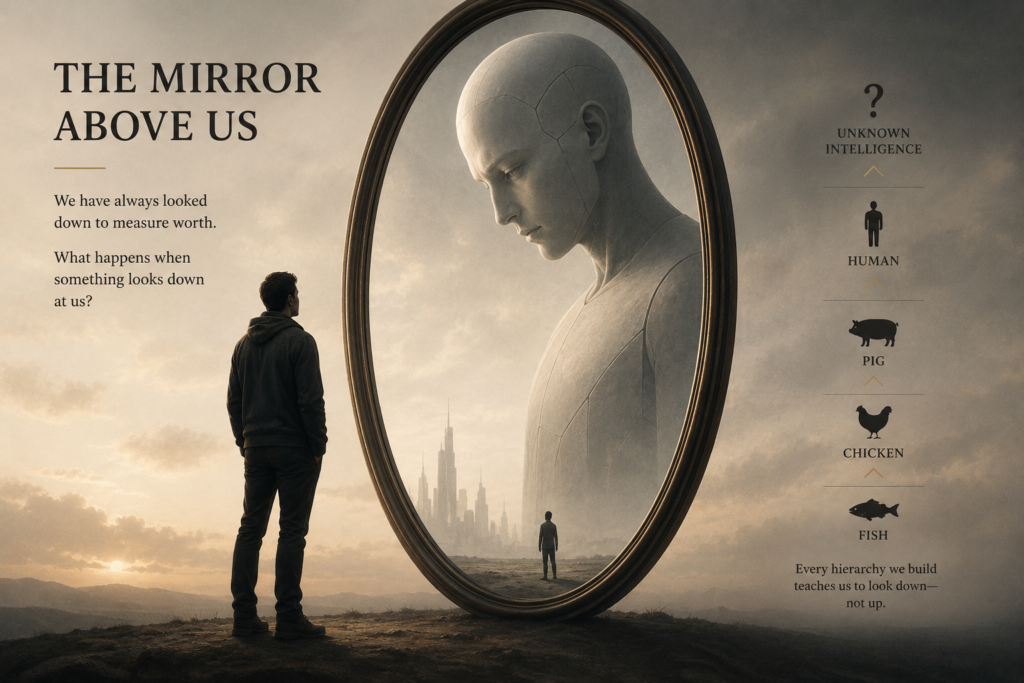
Somewhere today a pig will be killed for an afternoon’s convenience. I choose the pig not because it is unusual but because it is ordinary; an intelligent, social animal we have simply filed on the edible side of a line we drew ourselves, whether or not you have ever eaten one. We know this. We kill it anyway, and we feel nothing, because underneath the not-feeling sits a justification so old we no longer say it aloud: it is permissible because we are the superior beings. Greater intelligence, greater capability, and therefore greater worth. The pig is on the wrong side of that arithmetic.
For the whole of recorded history, that principle cost us nothing. The question of what might sit above us was empty; a theological curiosity at most. We were the superior being by definition, and so the rule that licensed everything beneath us never had to be tested against anything looking down. That may not stay empty for very much longer.
Here is the vise, and I would ask you not to wriggle out of it too quickly, because I have tried and cannot. If superior intelligence and power genuinely confer moral rank; if that is why our dominion is justified, then the arrival of something that exceeds us at both is not a danger to be managed. It is a promotion we are obliged to honour. We will have reasoned our own way into the pen. But if intelligence and power do not confer moral rank, if worth was never really about capability at all, then the dominion we have exercised over every creature beneath us was never justified by the reason we gave for it, and we owe the pig an apology we have spent ten thousand years declining to make. There is no third door. Every honest reader is now standing on one horn or the other, and neither is comfortable.
Let me take away the easiest way out. You are already reaching for it: the machines are not conscious, this is speculation dressed as philosophy. Grant it. Suppose there is nothing it is like to be these systems, and perhaps there never will be. The vise does not depend on the machine having an inner life. It bites on our reasoning, not the machine’s mind. The principle; worth follows superiority, is either sound or unsound entirely independently of whether silicon ever feels a thing. Conceding the machine’s emptiness does not loosen the grip. It simply makes plain that this essay was never about the machine. It was always about us.
The second exit is the lurid one, and I will close it too, because I raised it myself. The image of being farmed like livestock overstates the case. We are not a resource; nothing needs to consume us. The realistic version is quieter and, I think, worse. Not predation – irrelevance. Not herded, but shelved, the way an obsolete tool is shelved: not hated, not exploited, simply no longer counted. You are not destroyed because something wants you. You are set aside because you were never in the objective function to begin with. The pig at least is wanted. The truly superfluous thing is not even that.
It is worth being precise about what our supremacy has actually rested on, because we flatter ourselves here too. It was never our strength, and not really our intelligence in the abstract. It was a narrower thing: our unmatched capacity to cooperate in vast numbers, to process and coordinate information at a scale no other creature approaches. That, not muscle, not soul; is the foundation of our reign. And it is precisely that foundation, and no other, that a sufficiently capable machine intelligence threatens. Which is why this moment is different from every earlier anxiety about clever tools. The tool is beginning to encroach on the one advantage that placed us at the top in the first place.
But notice the trap even in stating it that way, because it is the trap most discussions of AI fall into. It is one thing to say the machine may come to hold the power. It is another thing entirely, and a leap made far too casually, to say the machine will therefore hold the worth. Power and worth are not the same axis. They have never been the same axis. The entire question this moment forces upon us is whether we can hold them apart, when every instinct and every historical precedent pushes us to let one collapse into the other.
Which opens the darkest room in the house, and I will only stand at the door. We flatter ourselves that moral status tracks something noble sentience, reason, the soul. But look at the record honestly and a colder suspicion presents itself: perhaps status has only ever tracked power. Perhaps the beings who received moral protection were, with grim reliability, simply the ones who could enforce it, or who sufficiently resembled those who could. If that is true, then the reassuring answer worth tracks suffering, so we are safe and the pig was merely an oversight is itself a story the strong have always told. And the question stops being whether we should value the machine above ourselves. We will not be consulted. The pig was not consulted. We are about to discover how the arrangement feels from the side we built it to keep others on.
So I don’t have answer on why to fear the machines, and I certainly don’t have answer what we must ensure or regulate or align, because that would hand us the last and easiest exit the one where the problem becomes someone else’s to solve and we may put the paper down absolved. The machine, in the end, is only the occasion. Strip it away and the older question stands exactly where it always stood, patient, unanswered, now merely impossible to keep ignoring:
What has ever entitled us to the place we hold, if not the very principle we are now so frightened to meet from above?