Economics
Environment
Finance
Policy
Technology
500 GW target, battery storage, coal flexibility, demand response, DISCOMs, duck curve, electricity market design, Energy policy India, energy storage, firm power, green energy corridors, grid integration, grid reliability, India energy transition, India renewable energy, Indian power sector, non-fossil capacity, nuclear power India, nuclear privatisation, peak electricity demand, power distribution, pumped hydro, RDSS, renewable curtailment, SHANTI Act, Small Modular Reactors, Smart Meters, time-of-day tariff, transmission infrastructure, variable renewable energy
AnilMehta
India built the capacity. Now it must deliver the power
India has all but won the race to add non-fossil capacity. The harder contest — making that power deliverable, flexible and affordable, just as demand begins to surge — is only starting. And it is a problem of system design, not more gigawatts.
On July 31 2026, when India crossed 300 gigawatts of non-fossil generating capacity, the milestone was real and worth stating plainly: non-fossil sources now make up more than 54 per cent of an installed base of around 552GW, built at a speed few forecast a decade ago. But it marks the end of one race, not the finish line.
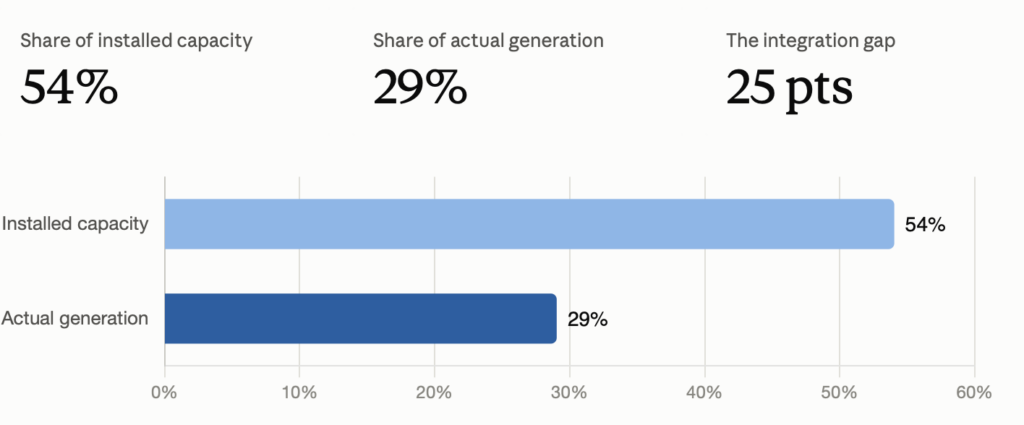
The revealing figure is a different one. Non-fossil sources are 54 per cent of what India has built, yet only about 29 per cent of the electricity it actually generated in 2025-26. That gap is not simply “the sun sets at night.” It is the sum of intermittency, transmission bottlenecks, curtailment, seasonal swings and, above all, the mismatch between when clean power is available and when it is wanted. India has largely solved the problem of adding generation. It has not yet solved the harder problem: making that generation simultaneously deliverable, flexible and affordable.
Put another way, the country is moving from an electricity system constrained by capacity to one constrained by flexibility, transmission, distribution and demand. The era of cheap generation is giving way to the era of cheap reliable electricity — and reliability is a property of the whole system, not a line on a spreadsheet.
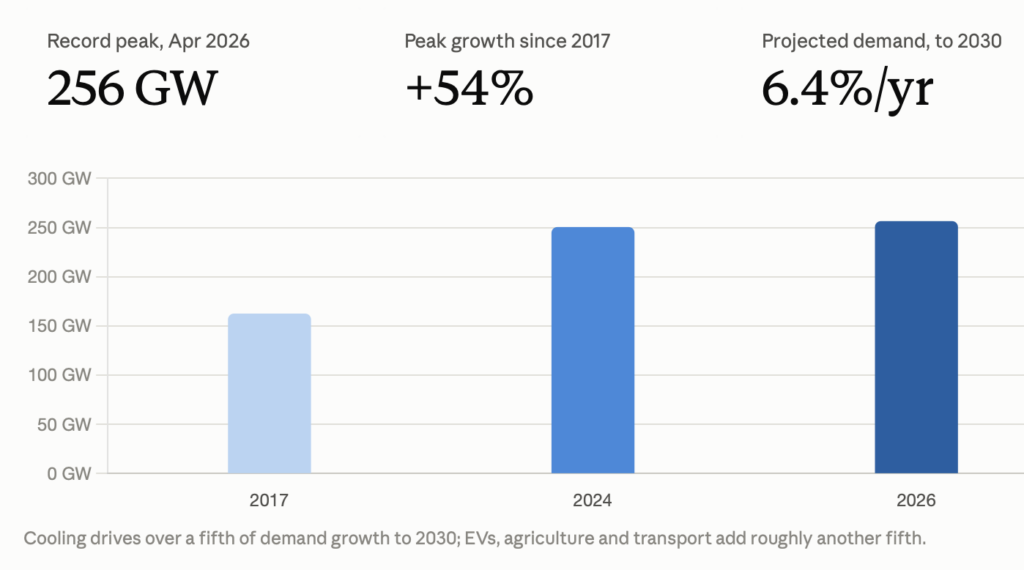
The urgency comes from the demand side. Peak demand hit a record 256GW in April 2026, and India’s peak load has climbed 54 per cent since 2017. The International Energy Agency expects consumption to grow around 6.4 per cent a year to 2030, adding more than 570 terawatt-hours, with air-conditioning alone driving over a fifth of that growth — before counting electric vehicles, data centres, electrified industry and farms. India is adding clean supply and a wave of new demand at the same time. A megawatt on a spreadsheet is not a megawatt the system can dispatch on a 45°C evening.
Six moves turn built capacity into reliable power.
The first is the least glamorous: build the wires before the generators. A solar park goes up in about eighteen months; the high-voltage corridor to carry its power takes far longer. The point is not the exact number of years — it is that generation and transmission are planned and financed on different clocks. Building the network ahead of the plants, along the renewable-energy zones India has already mapped, is what lets the grid actually use what has been built.
The second is to make coal flexible — and make the flexibility pay. India has begun forcing this: coal units must now be able to run down to 55 per cent of their capacity, with 40 per cent under active consideration. But the binding problem is no longer whether coal can bend; it is whether anyone is paid to make it. Running plants at low load raises heat rates, auxiliary consumption and wear, while many power-purchase contracts were written for flat baseload operation. Until the market rewards a plant for ramping down at noon and up at dusk, it is often cheaper to waste free solar. Coal is not the future — but it is the swing partner for the transition, and should be used, and paid, as one.
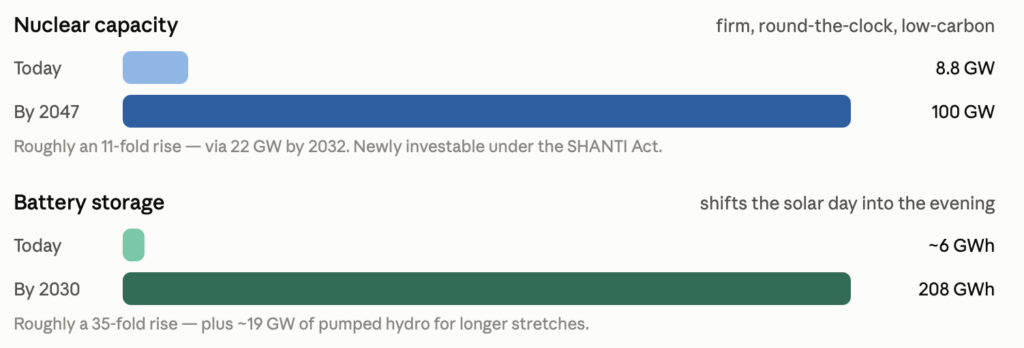
The third is to treat storage as grid infrastructure. This is the piece moving fastest. India had barely a few gigawatt-hours of batteries a year ago; capacity jumped more than ninefold in a single quarter, the project pipeline has crossed 100 gigawatts, and storage is now mandatory on new solar parks. Different jobs need different tools — batteries to shift the solar day into the evening, pumped hydro for longer stretches — but the principle is one: firm green power is cheap only if storage is treated as shared infrastructure, not each developer’s private burden.
The fourth is to open nuclear to private capital, carefully. Nuclear’s value is not chasing the sharp evening ramp — batteries and hydro do that better. It is supplying large volumes of predictable, low-carbon electricity around the clock, which shrinks how much variable renewable power the rest of the system has to firm. At about 8.8GW, roughly 3 per cent of generation, it has been held back by cost and monopoly, not physics. December’s SHANTI Act — which replaced the 1962 atomic-energy law and the 2010 nuclear-liability act and, for the first time, lets private and foreign firms build and operate reactors under licence — changes that, alongside a ₹20,000 crore push for home-grown small reactors that six of India’s largest industrial houses have already bid for. It should be done with eyes open. The operator remains strictly liable for any accident; what the new law removes is the operator’s statutory recourse against suppliers for defective equipment — a change critics fear weakens accountability, and one that puts real weight on the newly independent regulator. Nuclear is not the answer. It is one firm resource in a portfolio that is, for the first time, investable.
The fifth is to make demand a resource, not just a load. This is India’s most under-used asset. Rather than building supply to chase a fixed evening peak, price power to move the peak — cheaper by day, when solar is spilling over the grid, dearer at dusk. The country is full of loads that can flex: agricultural pumps, cold stores, factory shifts, EV charging, electrolysers, data centres. The cheapest battery in India may be a machine that has not been switched on yet; a flexible factory can be worth as much to the grid as a storage plant. And the very demand that threatens the evening peak — cooling, EVs — can ease it instead, if it is steered into the sunlit hours.
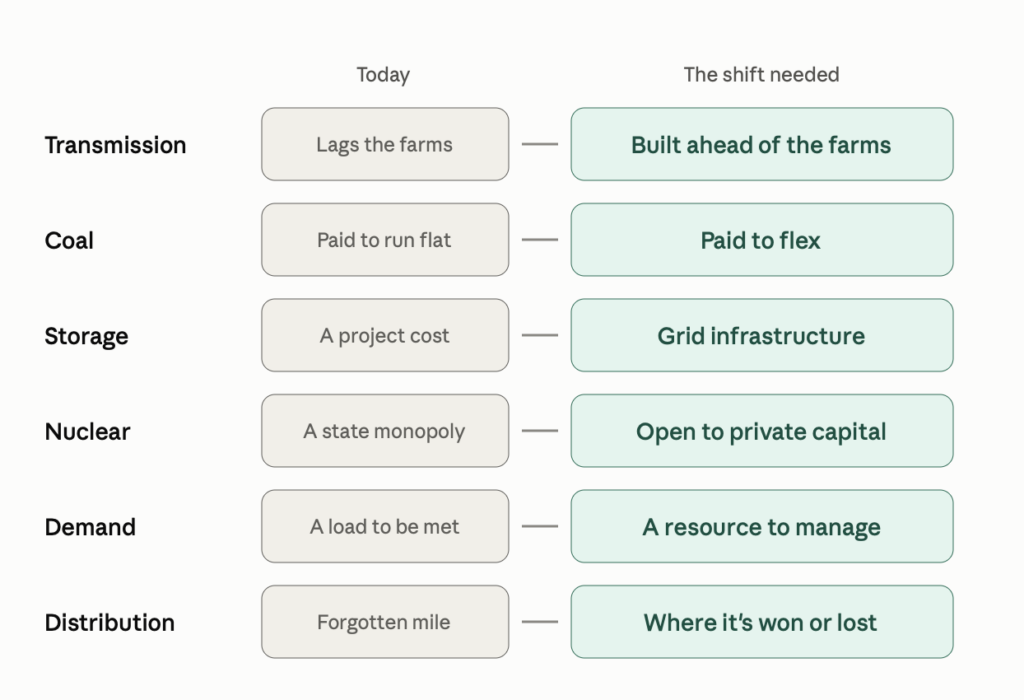
The sixth is the one most often forgotten: fix the last mile. The grid does not end at the transmission substation. India can build 500GW of clean capacity and the wires to move it, and still stumble where power meets the consumer — overloaded distribution transformers, weak feeders, rooftop solar pushing current backwards, unmetered farm demand, and smart meters that are installed but do not communicate. Every lever above, and flexible demand most of all, runs through the distribution companies and their meters. Time-of-day pricing is worthless if the meter cannot record the hour or the tariff never reaches the bill. Measuring the rollout by meters installed rather than meters working is how a good idea dies in the field.
Underneath all six is a single shift: India’s clean-energy revolution is moving from an engineering problem to a market-design problem. The first phase asked who could build solar cheapest. The next asks who pays for flexibility, who owns storage, how balancing and reserves are priced, how contracts accommodate ramping, how consumers are rewarded for shifting load, and how distribution companies survive buying power that varies by the hour. The grid will also need sharper weather and renewable forecasting and faster balancing markets — because a megawatt you cannot predict is one you must pay to back up.
None of this means slowing down on renewables. It means widening the definition of success — from megawatts, to megawatt-hours, to reliability. India has proved it can build clean capacity at extraordinary speed. The next milestone worth chasing is not another hundred gigawatts on paper. It is clean power that shows up, day and night, at a price the country can bear.
References –
- https://www.pib.gov.in/PressReleasePage.aspx?PRID=2250039&lang=1®=3
- https://renewablewatch.in/2026/08/11/india-crosses-300-gw-non-fossil-fuel-power-capacity/
- https://www.iea.org/reports/electricity-2026/demand
- https://solarquarter.com/2026/04/29/india-records-all-time-high-peak-power-demand-of-256-1-gw-meets-supply-without-shortage/
- https://www.downtoearth.org.in/energy/global-electricity-demand-set-to-surge-through-2030-as-data-centres-evs-and-cooling-drive-new-age-of-electricity-iea
- https://cea.nic.in/wp-content/uploads/notification/2022/07/Regulation_in_English.pdf
- https://www.mercomindia.com/cea-projects-national-power-requirement-to-touch-1121-gw-by-fy-2036
- https://powerpeakdigest.com/cea-panel-finds-55-mtl-flexible-operation-does-not-damage-thermal-units/
- https://www.mercomindia.com/india-adds-4-6-gwh-battery-energy-storage-capacity-q1-2026
- https://ieefa.org/sites/default/files/2026-08/ESSjmk-0626.pdf
- https://ieefa.org/sites/default/files/2025-04/The%20Standalone%20Energy%20Storage%20Market%20in%20India_April%202025.pdf
- https://www.world-nuclear-news.org/articles/indias-shanti-bill-completes-legislative-process
- https://prsindia.org/files/bills_acts/acts_parliament/2025/The_SHANTI_Act_2025.pdf
- https://world-nuclear.org/information-library/country-profiles/countries-g-n/india
- https://visionias.in/current-affairs/monthly-magazine/2026-01-28/science-and-technology/the-shanti-act-2025
- https://powermin.gov.in/en/content/electricity-rights-consumers-amendment-rules-2023
- https://www.reuters.com/business/energy/indias-tougher-grid-rules-unsettle-investors-test-clean-energy-ambitions-2026-06-04/