Economics
Finance
Philosophy
Policy
admission fraud, Bhavna Tiwari judgment, capitation fee, CBI investigation, Cockroach Janata Party, doctor population ratio, doctor shortage, education policy India, Enforcement Directorate, EWS quota, health ministry, healthcare policy, Institutional Reform, market design, matching markets, MBBS admissions, medical education, medical seat crisis, National Medical Commission, NEET, NEET PG, NEET UG, NMC, NRI quota, private medical colleges, regulatory capture, rent seeking, seat blocking, Sonam Wangchuk, Supreme Court
AnilMehta
Beyond the Protests – The Design Equilibrium of India’s Medical Crisis
India’s medical admissions system is routinely described as a scarcity problem contaminated by corruption. This note argues the causation runs the other way. Corruption in medical admissions is not a parasite on scarcity; it is the predictable output of an administered market in which a rationed, non-tradeable entitlement carries a shadow price several multiples of its regulated price, and in which residual allocation discretion is vested in the party that captures the difference. Three distinct extraction mechanisms — seat blocking, quota laundering, and regulatory capture at the approval stage — are documented against investigative and judicial record from 2021–2026. The note further argues that the dominant policy response, capacity expansion, is not neutral: because rent is generated at the point of approval, expansion enlarges the rent pool. Remedies are assessed on whether they attack the arbitrage, the discretion, or merely the actors.
1. The proximate context
The immediate political trigger is a leak of the medical entrance examination in May 2026 and the resulting cancellation of the paper. The activist Sonam Wangchuk began a fast at a protest site in central Delhi on 28 June 2026, in solidarity with the founder of the Gen Z-led Cockroach Janata Party, who was staging a sit-in demanding the resignation of Education Minister Dharmendra Pradhan. On 18 July, twenty days into the fast, Wangchuk was taken by Delhi Police to a state-run hospital against his will; the Delhi High Court subsequently permitted his transfer to a private facility. Protesters have camped in the capital for over a month, and more than 100 people were seriously injured in police action on 20 July.
The demand on the table is a resignation. The argument of this note is that the resignation is orthogonal to the problem. Ministerial accountability is a legitimate constitutional norm, but the extraction machinery described below has operated continuously across changes of minister, changes of regulator (MCI to NMC in 2020), and changes of government. It is a design equilibrium, not a personnel failure.
2. Interrogating the scarcity premise
Any reform proposal rests on a prior claim: that India is short of doctors. That claim requires more care than it usually receives.
2.1 The official position. The Union Health Ministry informed Parliament in December 2025 that there are 13,86,150 registered allopathic doctors and 7,51,768 registered AYUSH practitioners; assuming 80 per cent of both are available, the doctor-population ratio is estimated at 1:811. Over the same statement, medical colleges are reported to have risen from 387 to 818, UG seats from 51,348 to 1,28,875 and PG seats from 31,185 to 82,059 since 2014.
2.2 The composition problem. The 1:811 figure is a composite. AYUSH practitioners are not trained as MBBS doctors and do not manage emergency, surgical or intensive-care cases; health experts hold that including them misrepresents the availability of trained medical professionals. Restricting the numerator to allopathic registrations and applying the same 80 per cent availability assumption against a population of approximately 1.46 billion yields roughly one available allopathic doctor per 1,300 people. That is a materially different picture, though not the catastrophe sometimes claimed.
2.3 The register problem. Both figures are derived from registration stock, not practising stock. Indian state medical council registers are not systematically purged for death, retirement, emigration or non-practice. Any ratio computed from them is an upper bound of unknown looseness. The 80 per cent availability assumption is an administrative convention, not an estimate.
2.4 The benchmark problem — and this is the important one. The target against which shortage is declared does not exist. The notion of a 1:1000 doctor-to-population ratio as a norm for India rests on misattribution and is not supported by the WHO. The WHO’s 2006 World Health Report identified a threshold of 2.28 health care professionals per 1,000 population, revised in 2016 to 4.45 physicians, nurses and midwives per 1,000 — measures of health-worker density, not of doctors alone, and explicitly not substitutes for country-specific assessment. The earliest official Indian reference to a 1:1000 doctor target appears in the Medical Council of India’s Vision 2015 report of 2011; the Planning Commission’s High Level Expert Group on Universal Health Coverage then restated it as a “WHO norm” without source or reasoning, and the misattribution acquired the status of fact.
This is not a pedantic point. It reverses the historical record. The Bhore Committee in the mid-1940s recommended a target of 1:2000 by 1971; the Mudaliar Committee a decade after independence considered even that unnecessarily high and recommended 1:3000–1:3500; and by 1981 the Ramalingaswami Committee projected that India would soon have more doctors than it needed. By the early 1990s the government had decided not to open new medical colleges, and to strengthen paramedical institutions instead.
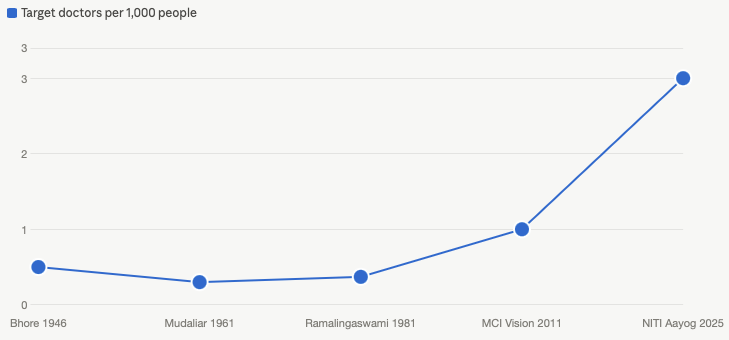
Figure 1. India’s official doctor-density target, 1946–2025. Values for 1946, 1961 and 1981 are derived from the Bhore, Mudaliar and Ramalingaswami Committee recommendations respectively; the 2011 value is from MCI Vision 2015; the 2025 value is the NITI Aayog goalpost for 2040. The 1946–1981 points follow committee deliberation; the 2011 discontinuity does not.
2.5 What the shortage actually is. The defensible version of the shortage claim is not aggregate. It is distributional and compositional. In 2021, 67.8 per cent of postgraduate specialist posts at Community Health Centre level were unfilled. Specialist density per million population is very low across categories — cardiologists 10, pulmonologists 2, neurologists 2, endocrinologists 1, nephrologists 2, surgeons 2. Rural doctor density is 3 per 10,000 against 13 per 10,000 in urban areas, and of 480 rural districts only 132 have a medical college.
Implication. The binding constraint is specialist training capacity, faculty supply, and geographic deployment — not undergraduate intake. A policy that expands MBBS seats without expanding PG capacity and faculty converts a doctor shortage into a graduate surplus with an unchanged specialist deficit. The Himachal Pradesh Chief Minister has publicly warned that new MBBS graduates may find themselves in the unemployment queue.
3. The arbitrage that creates the asset
Reduce the system to its economics. A medical seat has:
- a shadow price set by excess demand — 13,15,853 candidates cleared the NEET 2024 qualifying threshold out of 23,33,162 who sat the examination, against roughly 1,09,145 MBBS seats — approximately one seat per twelve qualified candidates, and about 63,000 government seats, meaning under five per cent of aspirants secure the subsidised option;
- a regulated price, fixed by state fee-fixation committees and court order;
- and a residual allocation right, which after the final counselling round devolves to the institution.
Rent per seat is approximately (shadow price − regulated price) × probability of capturing residual allocation. Every documented scam below is an attempt to raise one of those three terms. This framing matters because it tells you which interventions are structural and which are cosmetic: prosecuting participants leaves all three terms untouched.
A necessary caution on the qualification figure. The “13 lakh qualified” number should not be read as thirteen lakh candidates competent to practise medicine. NEET qualification is determined by percentile, not by a fixed competence mark — in 2025, 12,36,531 of 22,09,318 candidates, roughly 56 per cent, cleared the percentile cut-off. The 50th-percentile threshold is a floor for counselling eligibility, and in general category terms corresponds to a raw score in the low twenties as a percentage. Treating the qualified pool as suppressed supply of doctors is a category error, and it is the single most common analytical mistake in public commentary on this subject. The gap is real; its magnitude is not thirteen lakh.
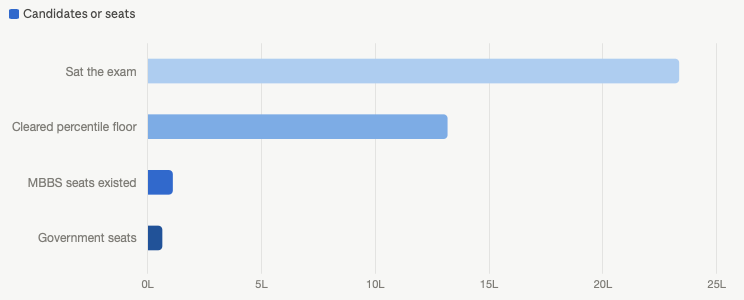
Figure 2. Attrition in NEET UG 2024, from candidates sat to government MBBS seats available. Sources: NTA revised merit list 2024; MCC seat matrix 2024. Note that the percentile floor is a counselling-eligibility threshold, not a competence threshold; the second bar should not be read as a count of candidates fit to practise medicine.
4. Mechanism one: seat blocking
Design. Counselling proceeds in sequential rounds so that vacated seats cascade to the next-ranked candidate. After the final round, unfilled seats revert to the institution to fill at its discretion. The exploit is to manufacture that reversion artificially.
Evidence. An Income Tax Department investigation in Karnataka found that high-ranking NEET candidates took admission through state counselling and blocked seats with no intention of joining; in connivance with agents and middlemen they withdrew after Karnataka Examinations Authority counselling concluded, converting merit seats into management seats filled through the stray-vacancy round. Evidence indicated ₹402.78 crore accepted as undisclosed capitation fees, illegal under the Karnataka Educational Institutions (Prohibition of Capitation Fee) Act, 1984. The investigation also found evidence that one college operated a fixed-price arrangement for passing management-quota students in written and viva examinations.
In Telangana, the Enforcement Directorate searched 12 medical colleges across 16 locations in June 2023. Seats had been blocked using the credentials of candidates who, when contacted by Kaloji Narayana Rao University of Health Sciences, confirmed they had never applied; the university suspected transfer of blocked seats into the NRI quota for financial gain. The agency reported seizing records of cash transactions running into hundreds of crores, froze ₹2.89 crore in bank deposits and seized ₹1.4 crore in unaccounted cash, stating that stray-vacancy seats were sold at premiums between ₹1 crore and ₹2.5 crore. Notably, where the university had imposed penalties on defaulting candidates, the investigation found the penalties were being paid on the blockers’ behalf out of the sale premium.
That last detail is the most instructive sentence in the entire evidentiary record. A penalty priced below the rent is not a deterrent; it is a line item. Any remedy that relies on fining the seat-blocker will be absorbed into the transaction.
Judicial response. In State of U.P. v. Bhavna Tiwari & Ors., decided 29 April 2025, a bench of Justices J.B. Pardiwala and R. Mahadevan issued comprehensive directions to reform medical admissions nationwide, noting reforms since 2018 including security deposits, fully online counselling, debarment for seat vacating, and expansion from two to four counselling rounds. The ten directions appear at paragraph 16 of the judgment, reported as 2025 INSC 747, and include a common national counselling calendar, mandatory pre-counselling fee disclosure, a structured post-Round-2 upgrade window, Aadhaar-linked identity verification at reporting, action against state Directorates of Medical Education for schedule violations, and blacklisting of complicit colleges. The Court additionally directed the National Board of Examinations to publish raw scores, answer keys and the normalisation formula.
The directions are well-designed. Their weakness is that compliance sits with the same state authorities and institutions whose discretion they curtail, and no independent compliance audit or public reporting mechanism attaches to them. Establishing the actual implementation status of each of the ten directions, state by state, would be the single highest-value administrative exercise available to a health or education secretary today. No such consolidated compliance record appears to be in the public domain.
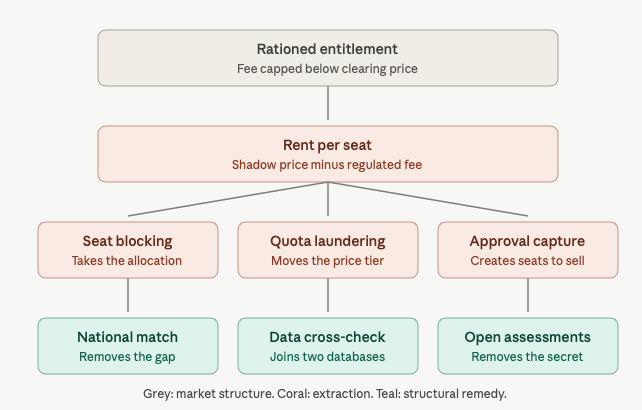
Figure 3. Rent extraction architecture in Indian medical admissions. Each documented mechanism attacks a different term in the rent equation, and each has a corresponding structural remedy that does not depend on prosecuting participants.
5. Mechanism two: quota laundering
Two reserved categories sit at opposite ends of the fee spectrum: the NRI quota, priced at a multiple of standard fees, and the EWS quota, intended for candidates from families below an income threshold. Both have been captured, and — this is the striking finding — often by the same individuals.
NRI quota. An Enforcement Directorate investigation conducted with the Ministry of External Affairs found that private medical colleges facilitated admission to nearly 18,000 NEET UG and PG seats using forged NRI certificates. Colleges worked with admission agents and paid intermediaries to prepare fabricated documents, and a single credential was reused across multiple candidates. Raids in West Bengal and Odisha recovered counterfeit US notary stamps, forged NRI certificates and fabricated family trees showing unrelated foreigners as relatives of candidates; hundreds of certificates sent to Indian embassies for verification were found to be fake. Fees were paid by the students’ resident families rather than by NRI sponsors, defeating the foreign-exchange rationale of the quota. Some genuine NRIs were paid by agents to lend their names as sponsors to students they had no relation to.
NRI seats account for roughly 15 per cent of India’s approximately 1.2 lakh MBBS seats. Following the probe, the MEA and Medical Counselling Committee tightened norms for 2025-26: embassy-issued certificates are now verified through the MEA and Indian High Commissions, admissions on fake certificates are cancelled with punitive action against both candidate and college, and unfilled NRI seats revert to management quota. The agency noted the findings extend beyond medicine, as NRI quotas exist in law, management and other higher education streams.
EWS quota. Analysis of NEET counselling data found 378 students claiming EWS status securing MBBS seats across 54 deemed universities not through the reserved quota but through management quota, paying total fees between ₹87.5 lakh and ₹1.67 crore over five years, against an EWS eligibility ceiling of ₹8 lakh annual family income. A further 33 EWS-tagged students were admitted under NRI quotas across 20 deemed universities at an average total fee of ₹2.13 crore, one with a NEET rank of 6,61,975. At postgraduate level, 148 EWS-category candidates took management or NRI quota seats costing around ₹1 crore. NMC Chairperson Dr Abhijat Sheth stated these were allocated during state counselling rather than under all-India quota, and that states should investigate and act.
Analytical note. The EWS finding is not primarily a story of the rich stealing poor students’ seats, though it is that. It is a documentary-integrity failure: the same person holds a certificate attesting to an income below ₹8 lakh and pays fees of ₹2 crore. Both facts sit in government-accessible records. The fraud survives only because the two datasets are never joined. This is a solvable engineering problem, not a moral one.
6. Mechanism three: capture of the approval gate
The most consequential extraction occurs before a single student applies.
On 30 June 2025 the CBI named 34 persons in an FIR alleging graft and manipulation of the regulatory framework governing medical colleges, including eight Health Ministry officials, one from the National Health Authority, and five doctors serving on NMC inspection teams. Also named were the chairman of the Tata Institute of Social Sciences, D.P. Singh; the Registrar of Gitanjali University; the chairman of Rawatpura Institute of Medical Sciences and Research; and the chairman of Index Medical College. Eight persons were arrested, including three NMC assessors allegedly caught accepting a bribe of ₹55 lakh for a favourable report on the Naya Raipur institute.
According to the FIR, officials of the Ministry of Health and Family Welfare and the NMC allegedly conspired to leak confidential regulatory documents relating to inspections, recognition and renewals, photographing internal ministry files and transmitting them via personal mobile phones to middlemen linked to private colleges. The disclosures allegedly enabled colleges to stage compliance through ghost faculty, falsified biometric attendance and admission of fictitious patients. The CBI estimated that over 40 medical colleges secured approvals through such means, with raids across Delhi, Bhopal, Raipur, Indore, Hyderabad and Chennai. The NMC subsequently blacklisted four assessors pending the outcome, declined to renew existing UG and PG seats at six colleges for 2025-26, and cancelled their pending applications for new courses and seat increases. The Enforcement Directorate conducted associated raids on medical colleges across ten states in November 2025.
These are allegations under investigation; no finding of guilt is recorded against any named person.
Why this mechanism dominates the other two. Seat blocking and quota fraud redistribute seats within an approved institution. Approval fraud creates the institution. It determines whether the patient in that district is treated by someone taught by real faculty on real cases. NMC inspections have found a large number of colleges with inadequate infrastructure, faculty absent during teaching hours, deficient clinical material including a shortage of cadavers for anatomy instruction, and unresolved student grievances; reporting in 2024 indicated that four in five medical colleges failed the regulator’s minimum standards. The NMC has declined to make its college assessment reports public.
The refusal to publish assessment reports is, in institutional-design terms, the load-bearing failure. It converts every inspection into a bilateral, unobserved encounter between an assessor and an interested party — precisely the structure that makes bribery rational for both.
7. Why the expansion response is not neutral
The standard remedy proposed — build more colleges, create more seats — deserves scrutiny, because it is the one policy the government has consistently executed. India had 314 medical colleges in 2011 and 780 by July 2025, the most of any country, with Brazil a distant second at 389. Many new colleges since 2010 have been commercial ventures, in several cases involving the transfer of established public district hospitals to private entities as a concession for college construction. Medical teacher numbers have not kept pace with college numbers.
Three consequences follow, and they are structural rather than incidental:
- Expansion enlarges the rent pool. Rent is generated at the approval gate. Each new approval is a new transaction opportunity for the network described in Section 6. Capacity expansion administered through a captured approval process is not a solution applied to corruption; it is a subsidy to it.
- Expansion without faculty is self-defeating and generates the fraud it needs. A college that cannot staff itself must simulate staffing. Ghost faculty is not a coincidental abuse; it is the necessary consequence of approving colleges faster than the system produces teachers. And teachers come from postgraduate training — the very bottleneck expansion was meant to relieve. The system is circular.
- Expansion at UG level without matching PG capacity manufactures a new grievance. With 1,28,875 UG seats against 82,059 PG seats — and the clinical MD/MS subset materially smaller than that headline — roughly a third of graduates cannot specialise. Since specialists, not generalists, are the acute deficit identified in Section 2.5, undergraduate expansion addresses the wrong margin.
Conclusion of this section. “More seats” and “less corruption” are not complementary objectives under the present regulatory architecture. They are in tension. Sequencing matters: approval integrity must precede expansion, not accompany it.
8. Assessment of proposed remedies
8.1 A binding national matching mechanism. The strongest available proposal. The United States National Resident Matching Program applies a deferred-acceptance algorithm derived from the Gale–Shapley procedure, work for which Alvin Roth and Lloyd Shapley received the 2012 Sveriges Riksbank Prize in Economic Sciences. Its relevant properties are a single simultaneous clearing with no sequential rounds, and a binding participation agreement whose violation carries multi-year debarment.
Applied to India, this eliminates the temporal gap between vacation and institutional refill — the gap on which seat blocking depends. It is consistent with the Supreme Court’s direction for a common national calendar.
But the analogy is incomplete, and this should be stated honestly to any officer. US residency positions are largely funded through Medicare graduate medical education payments; the training hospital is not selling the position. In India the college is simultaneously the regulated seller of a rationed good and the residual allocator of it. Deferred acceptance removes the discretion term from the rent equation. It does nothing to the arbitrage term. A matching algorithm alone will not stop capitation; it will move it earlier in the process. Matching must be paired with fee-transparency enforcement and a single-price rule across quota categories within a college, or the rent simply relocates.
8.2 Automated quota verification. Straightforward, cheap, and overdue. EWS certificates should be validated against PAN-linked income tax records; NRI sponsorship against MEA and immigration data — a verification chain the MEA and MCC have already begun constructing for 2025-26. The requirement is a data-sharing protocol between CBDT, MEA and MCC, not new legislation. Publication of anonymised quota allotment records with fee paid would allow external detection of the ₹8 lakh income / ₹2 crore fee contradiction at near-zero cost to the state. Note the privacy constraint: publish the contradiction, not the identity.
8.3 Replacing episodic inspection with continuous telemetry. The CBI case turned on the leak of inspection schedules— which means the asset being sold was foreknowledge of a discrete observation event. Better inspectors do not remove that asset; abolishing the discrete event does. Faculty attendance verified continuously through biometric and Aadhaar-linked records, patient census drawn from hospital management systems and ABDM rails, and cadaver and equipment inventories under continuous digital audit make advance warning worthless because there is no moment to prepare for. Combined with mandatory publication of assessment reports, this is the highest-leverage intervention available and requires no statutory amendment.
8.4 Regulatory independence and remuneration. Frequently proposed, weakest in evidence. The proposition that high salaries eliminate corruption is drawn from a single jurisdiction with a distinctive administrative history and does not transfer cleanly. More to the point, the NMC’s problem is not that assessors are poorly paid relative to a professional benchmark; it is that the value of what they control — an approval worth crores annually in perpetuity — exceeds any salary a state could plausibly offer. Where the controlled asset is worth ₹100 crore, no salary is high enough. The answer is to reduce what any individual controls, not to raise what they are paid for controlling it.
8.5 Ministerial resignation. As argued at the outset: a legitimate constitutional demand, and irrelevant to the mechanisms in Sections 4–6. Every one of them predates the incumbent minister and none is administered by the education ministry — medical education sits under Health and Family Welfare and the NMC. This is worth stating plainly, because the protest movement’s demand is aimed at the wrong department.
9. Recommendations
Ordered by ratio of effect to administrative cost.
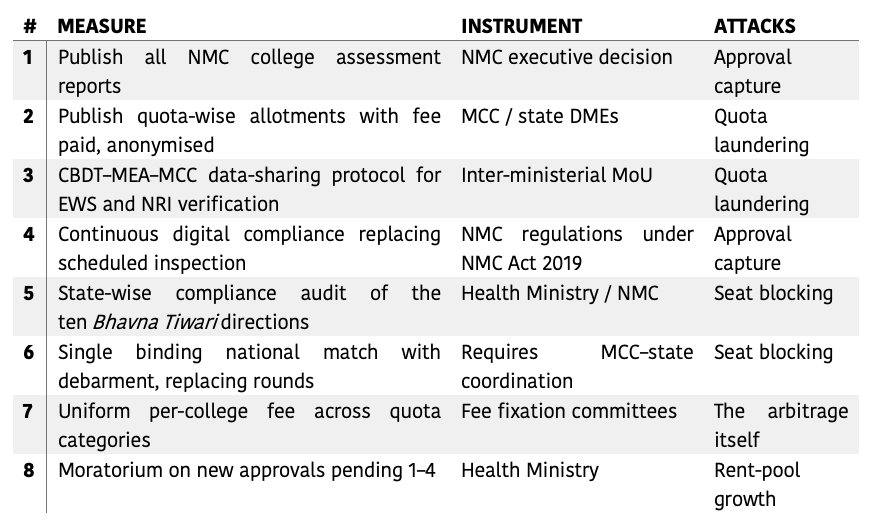
Measures 1 and 2 require no new law, no new money and no new institution. They can be executed within a quarter. Their absence, after a decade of documented scandal, is the clearest available evidence that the constraint is not capability.
10. Conclusion
The recurring public framing — that a corrupt few have infiltrated a sound system — inverts the diagnosis. The system produces the behaviour. So long as an entitlement worth crores is allocated at a price of lakhs, and the party that captures the difference retains discretion over the final allocation, participants with no particular disposition toward wrongdoing will find the arbitrage. Prosecutions remove participants; the position remains open and is refilled.
The corollary is uncomfortable for both sides of the current argument. The protesters are demanding the resignation of a minister who does not administer medical education. The government is prosecuting a scandal while accelerating the approval process that generated it. Both are addressing the actors. Neither is addressing the price.
The unglamorous measures — publishing an inspection report, joining two government databases, fixing one price per college — are the ones that would work. They are also the ones nobody is protesting for.
References
- Al Jazeera, “India protest: How Modi’s refusal to sack education minister fits a pattern,” 22 July 2026.
- Al Jazeera, “Indian activist Wangchuk urged to end hunger strike over exam paper leaks,” 14 July 2026.
- CBS News, “Appeals for prominent Indian activist to end hunger strike,” July 2026.
- Foreign Policy, “India: Why a Hunger Strike Is Rallying Cockroach Protesters,” 21 July 2026.
- Press Information Bureau / Ministry of Health and Family Welfare, reply to Rajya Sabha on doctor-population ratio, 2 December 2025 (PRID 2197614).
- The Federal, “India’s ‘1:811’ doctor-population ratio: Why are AYUSH practitioners counted?”, 5 December 2025.
- Kumbhar, Kiran, “A Costly Number is Behind India’s Medical Education Woes,” The India Forum, 15 August 2025.
- World Health Organization, World Health Report 2006; and Global Strategy on Human Resources for Health: Workforce 2030, 2016.
- Health Survey and Development Committee (Bhore Committee), Report, 1946; Health Survey and Planning Committee (Mudaliar Committee), 1961; Ramalingaswami Committee, Health for All: An Alternative Strategy, 1981.
- Medical Council of India, Vision 2015, 2011; Planning Commission High Level Expert Group on Universal Health Coverage, Report, 2011.
- Journal of Integrative Medicine and Public Health, “Beyond Numbers: Enhancing Healthcare Quality in India,” October 2025.
- National Testing Agency, NEET UG 2024 and 2025 results and revised merit lists.
- Medical Counselling Committee, NEET UG Counselling seat matrices, 2024–2026.
- Press Trust of India, “Govt officials among 34 booked by CBI for manipulation of regulatory framework for medical colleges,” 5 July 2025.
- Central Bureau of Investigation, FIR No. RC2182025A0014 dated 30 June 2025, under the Prevention of Corruption Act 1988 and Bharatiya Nyaya Sanhita 2023.
- National Medical Commission, notification on blacklisting of assessors and cancellation of seat approvals, July 2025.
- Outlook India, “CBI Uncovers Widespread Bribery Scandal in India’s Medical Colleges,” 6 July 2025.
- Deccan Herald, “ED raids medical colleges in 10 states in bribery case,” 27 November 2025.
- State of U.P. & Anr. v. Miss Bhavna Tiwari & Ors., 2025 INSC 747, Supreme Court of India, 29 April 2025 (Pardiwala and Mahadevan JJ), directions at para 16.
- The Tribune, “ED exposes NRI quota scam in West Bengal, Odisha medical colleges,” 2025.
- Careers360, “MBBS admission scam exposed; 18,000 NEET UG, PG seats filled using forged NRI certificates,” 25 August 2025.
- Careers360 / Medicine, “EWS Quota in NEET is Backdoor Entry for the Rich,” 4 September 2025.
- Medical Dialogues, “148 EWS category students take around Rs 1 crore Management, NRI quota seats, NMC calls for state-level probe,” 30 November 2025.
- Deccan Herald, “Income Tax Department unearths Rs 400 crore medical seat blocking scam in Karnataka.”
- Medical Dialogues, “Seat Blocking Scam in Telangana: ED Raids 12 Medical Colleges,” 26 June 2023; PTI/Careers360, ED statement on Telangana seat-blocking, 22 June 2023.
- The South First, “How private medical colleges blocked and sold PG seats in Telangana,” 30 November 2024.
- Roth, A.E. and Peranson, E., “The Redesign of the Matching Market for American Physicians,” American Economic Review, 1999; Gale, D. and Shapley, L.S., “College Admissions and the Stability of Marriage,” American Mathematical Monthly, 1962.
- Karnataka Educational Institutions (Prohibition of Capitation Fee) Act, 1984.