Economics
Finance
Policy
Technology
AMISP, AT&C, contingent liabilities, counterparty risk, DISCOM finance, electricity regulation, Energy policy India, Indian power sector, infrastructure finance, LPS Rules 2022, mart meters, Ministry of Power, power distribution, Power Finance Corporation, prepaid metering, public private partnership, RDSS, risk allocation, state guarantees, TOTEX
AnilMehta
AMISP – India’s smart meter programme
The financing model was right. The enforcement architecture that should have come with it was never built
Uttarakhand has spent the past few weeks arguing about smart meters. The complaints are the ones you hear wherever these boxes go up: a bill that doubled, a bill that never arrived, a reading nobody in the office can explain.
It sent me back to the device itself, and to something I found myself saying to someone recently. A smart meter has to be about as precise and as robust as an aircraft. But an aircraft lands. It goes into a hangar, gets stripped down and inspected on a schedule, sits out the weather it wasn’t built for. A meter does none of that. It is bolted to an outside wall and asked to keep measuring — and now to keep communicating — through every summer and every monsoon, for a decade, unattended, with nobody looking at it unless something has already gone wrong. No rest, no shelter, no maintenance window.
Whether that demand is being met is a legitimate argument and Uttarakhand is entitled to have it. This piece is about something else: not the box on the wall, but the arrangement behind it, which almost nobody outside the sector has looked at.
Because here is the part that surprises most people. In most of India, the utility does not own that smart meter. It did not buy it, and it will not finish paying for it for years.
Under the Revamped Distribution Sector Scheme, an Indian distribution utility does not buy a smart meter. It signs a contract with an Advanced Metering Infrastructure Service Provider, who raises the debt and equity, procures the hardware, installs it within 24 to 30 months, operates it for a further 93 months, and is paid a fixed fee per meter per month throughout. The centre contributes a subsidy capped at 15 per cent of cost or ₹900 per meter, rising to 22.5 per cent or ₹1,350 in special category states.
The rest is the utility’s obligation, month after month, for the better part of a decade.
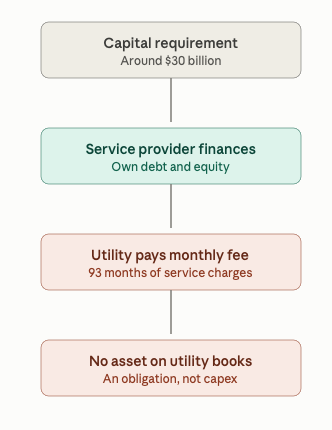
Let me say at the outset what this argument is not. It is not a case against the model. Distribution companies could not fund this outlay; moving it to parties who could was the right call, and the alternative — public procurement on state budgets — would have delivered fewer meters, later, or none at all. Seven crore meters exist because of this structure.
The problem is narrower and entirely fixable. The financing was privatised. The enforcement was not.
Start with delivery, because the schedule slipped first.
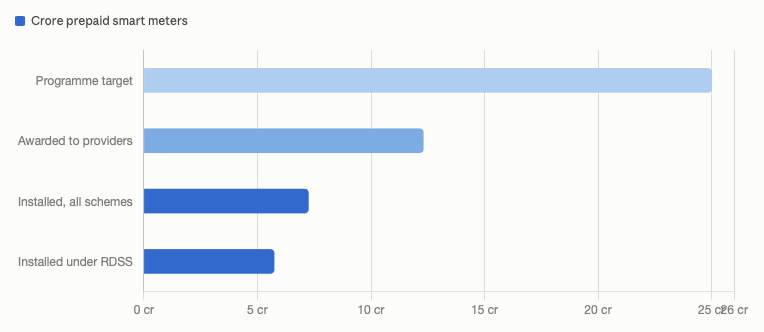
The original completion date was March 2026; the scheme document carried a fixed sunset of 31 March 2026. The working deadline is now March 2028. Crisil, examining providers responsible for more than 60 per cent of awarded projects, found that of 12.3 crore meters awarded, 2.56 crore had been installed by July 2025 where roughly 6 crore should have been. Of ₹30,065 crore allocated in the scheme’s first four years, about ₹5,664 crore had been spent by February 2025 — a shortfall the Parliamentary Standing Committee on Energy has flagged.
Then the payments. Crisil reports providers facing delays of 90 to 180 days against a framework that envisaged settlement within a month. Assuming a six-month cycle persisting across the ten-year contract, alongside execution delays of six to twelve months, project internal rates of return fall by up to 150 basis points — about 60 of them from the installation lag, the rest from working capital and interest on money that should already have arrived.
The obvious response is that this is exactly what TOTEX is for. The provider is meant to carry risk; that is what it is being paid for. If it bid badly, that is its problem.
That response is right about half the risks and wrong about the other half, and the line between them is not arbitrary. It is the oldest principle in infrastructure contracting: risk should sit with the party best able to control it.
Execution risk belongs to the provider without argument, and the piece takes none of it back. Installation pace, hardware costs, exposure to imported printed circuit boards and semiconductors and therefore to the rupee, meter failure rates, communication reliability, service levels — all of these are things a provider chooses, manages and can hedge. If it bid an aggressive schedule and missed it, the loss is properly its own.
Counterparty payment risk is different in kind. The provider cannot choose its customer: the utility is a regulated monopoly and the sole buyer. It cannot diversify across customers, cannot withhold service, cannot accelerate, cannot price-discriminate. Whether it gets paid is determined by tariff orders, state subsidy releases and the political economy of electricity pricing — none of which appear anywhere in its contract.
Which produces the formulation that matters. TOTEX transfers delivery risk efficiently, because the provider controls delivery. It cannot transfer counterparty credit risk efficiently, because the provider controls nothing on that side. Risk allocated to a party with no lever is not transferred. It is priced, and handed straight back to the buyer with a financing margin attached.
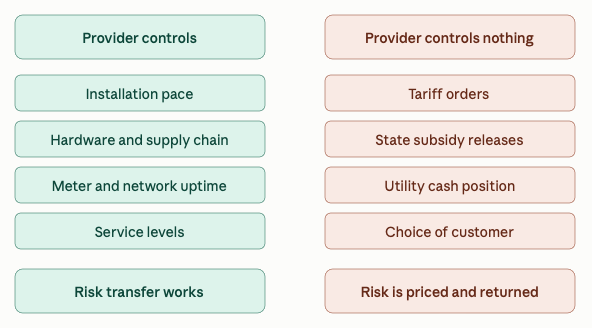
That is also the answer to the objection that providers entered these contracts voluntarily and should live with what they priced. Risk that is priced is not risk avoided; it is risk purchased, at a premium, by whoever is paying the bill. If providers priced a six-month cycle into their per-meter-per-month rates, distribution utilities are paying that premium every month for 93 months across every meter installed. The state can extinguish that risk at almost no cost, because it already owns the instrument. A private lender cannot extinguish it at any price — it can only charge for it.
So the question is not whether service providers deserve protection. It is why distribution companies are paying a nine-year credit-risk premium for a risk the government could remove with an amendment.
And there is a precedent, because the government has already done exactly that — for a different set of creditors.
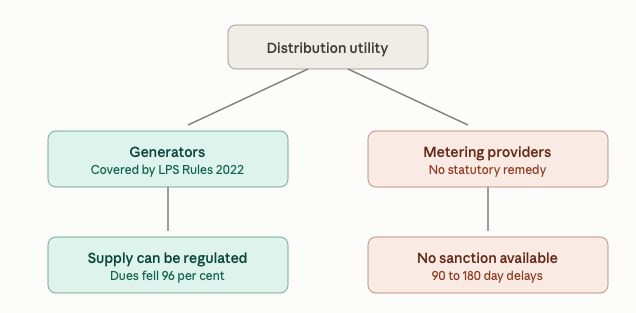
In 2022 distribution companies owed generators ₹1.39 lakh crore. The Late Payment Surcharge Rules rescheduled those arrears into up to 48 interest-free instalments with financing support from PFC and REC, and attached a sanction: a utility that misses current dues faces regulation of its access to power. Its lights can be turned off. Dues to generators subsequently fell by around 96 per cent. Those rules cover generating companies, inter-state transmission licensees and electricity trading licensees. They do not cover service providers.
Note what this settles. Generators also had power purchase agreements with payment clauses and arbitration rights in 2022, and the Ministry of Power did not consider those sufficient. The question of whether contractual remedies work against a distribution licensee has already been adjudicated by the government, and answered in the negative. The open question is only why the answer was scoped to three creditor classes and not four. In any case, a remedy that requires arbitrating against your sole customer with eight years left to run is not a remedy; it is a termination event wearing a clause, and the eventual award lands against an entity whose ability to pay is the thing in dispute.
The remaining defence is that six-month cycles are early-programme friction that will resolve as projects mature. Some of it certainly is — first-cycle process setup, head-end and meter data management integration, disputes over data validation before payment release. Those do work themselves out.
But the rating data contains a clean test of whether the rest will, and it points the other way. Days payable to generators ran 131, 132 and 113 days across the last three years. That 113 days is a figure achieved with a statutory disconnection threat in full force, and 23 utilities still scored nil on the metric for exceeding 90 days. With a sanction, discoms pay in 113 days. Without one, providers report 90 to 180.
The sanction compresses the tail. It does not change the underlying behaviour, because the behaviour is driven by cash position rather than process maturity — and the cash position has not moved. Days receivable stand at 112, against 113 the year before and 117 the year before that. Crisil, for its part, models the six-month cycle persisting across the full ten-year tenure. Ratings agencies do not model teething trouble over a decade.
There is a falsifiable version of this, and it should be stated plainly: if the delay is transitional, payment cycles should shorten measurably as individual projects pass out of their installation phase. If it is structural, they will instead track each utility’s own cash position. Both are checkable within two years.
Which brings us to what the programme was supposed to deliver, and here the case for caution has to be made carefully.Aggregate technical and commercial losses are an imperfect test, and the fair objections should be granted before the number is used. Meters installed during a year cannot show up in that year’s outcome; the lag is real. And smart metering’s deeper payoff is energy accounting at feeder and transformer level, which localises theft rather than reducing losses directly.
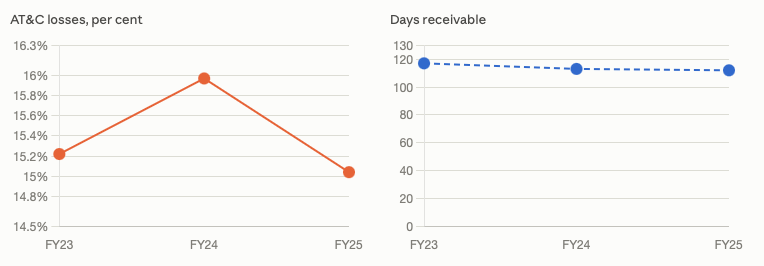
Grant both, then widen the test rather than abandon it. The loss series is drawn here on a tight axis because the story is its shape: the widely reported fall from 15.97 to 15.04 per cent follows a rise from 15.22, so two years of accelerating installation have produced 0.18 percentage points. Billing efficiency, the metric most directly attributable to metering accuracy, moved from 86.88 to 87.59 per cent over the same period. Collection efficiency, which prepayment should move hardest, went from 96.60 to 97.00 per cent in the latest year. PFC’s separate performance report puts the middle year’s losses higher still, at 16.4 per cent. And when the rating report attributes the latest reduction, it credits feeder segregation, low-tension to high-tension conversion and anti-theft drives; smart metering appears among its best practices, not at the head of its causal account.
Three tests, all pointing the same way, all moving at the same slow rate.
The receivables chart is drawn from zero, because there the story is flatness. The specific promise of a prepaid meter is that it turns a receivable into an advance. Seven crore meters have gone in and the number has moved four days in three years, with 19 utilities still beyond 120 days.
The most likely explanation is not that meters do not work. It is that installation is the first of four gates. The meter must communicate, its data must reach the utility’s backend, and the consumer must actually be migrated to prepaid mode. Only the first is published. Nobody reports how many of the 7.24 crore are billing in prepaid mode — which is, in the end, the only number that tests the business case.
So the country has committed to roughly a decade of contractual payments, sitting on the balance sheets of enterprises whose borrowings stood at ₹7,42,461 crore in March 2024 and whose guarantees account for 47 per cent of all outstanding state government guarantees, in exchange for a benefit the published data does not yet establish.
Three fixes would help, and none requires new money.
Extend an LPS-style enforcement mechanism to metering service contracts, with the cost premium it removes taken out of the next round of bids rather than left as margin. The instrument exists, it demonstrably works, and there is no principled reason a generator’s invoice is enforceable and a service provider’s is not.
Publish activation, not installation. Report meters communicating, meters integrated with billing, and meters operating in prepaid mode, state by state. If the case for the programme is prepayment, measure prepayment.
Disclose the commitment. Per-meter-per-month obligations across the remaining contract tenure are known, contracted, multi-year liabilities. They should appear as such, in the utility’s accounts and in the state’s statement of power sector exposure.
India got the hard part right. It found a way to finance a $30 billion capital programme without asking insolvent utilities to fund it. What it did not do was extend to the new creditors the single protection that made the last set of creditors whole. The programme’s real risk was never that the meters would not work. It is that India will spend a decade paying a premium for that omission, while arguing about whether they did.
References
- Power Finance Corporation / Ministry of Power, 14th Annual Integrated Rating and Ranking of Power Distribution Utilities (FY 2024-25), released 23 January 2026 — Exhibit 1 (AT&C losses 15.22 per cent FY23, 15.97 per cent FY24, 15.04 per cent FY25; billing efficiency 86.88, 86.99, 87.59 per cent; collection efficiency 96.60 per cent FY24 to 97.00 per cent FY25); Exhibit 3 (days receivable 117, 113, 112; 19 utilities above 120 days); Exhibit 4 (days payable to generators and transmission companies 131, 132, 113; 23 utilities above 90 days scoring nil); “Strategic Loss Reduction and Revenue Protection”, p. 7.
- Power Finance Corporation, Report on Performance of Power Utilities 2023-24, May 2025 — AT&C losses of 16.4 per cent in FY24.
- Ministry of Power, Guidelines: Revamped Distribution Sector Scheme — Reforms-based and Results-linked — AMISP structure, target of 25 crore prepaid smart meters, scheme sunset of 31 March 2026.
- Prayas (Energy Group), Smart Metering in India: A Work in Progress, 2025 — 93-month O&M tenure; per-meter-per-month fee derivation; central subsidy of 15 per cent or ₹900 per meter for general category states, 22.5 per cent or ₹1,350 for special category states.
- Crisil Ratings, analysis of AMISP project returns under RDSS, October 2025 — 2.56 crore of 12.3 crore awarded meters installed as of July 2025 against approximately 6 crore on schedule; payment delays of 90 to 180 days against an expectation of under one month; IRR impact of up to 150 basis points, of which about 60 basis points from installation lag; exposure to imported printed circuit boards and semiconductors; study covering providers with over 60 per cent of awarded projects.
- Ministry of Power, reply of the Minister of State for Power to Parliament — 7.24 crore smart meters installed as of 30 June 2026, of which 5.73 crore under RDSS.
- Standing Committee on Energy, report on RDSS implementation — approximately ₹5,664 crore of ₹30,065 crore allocated in the scheme’s first four years utilised as of 10 February 2025.
- Ministry of Power, Electricity (Late Payment Surcharge and Related Matters) Rules, 2022, notified 3 June 2022 — scope limited to generating companies, inter-state transmission licensees and electricity trading licensees; rescheduling into a maximum of 48 interest-free monthly instalments; regulation of power supply access on default; PFC as nodal agency. Dues position from the PRAAPTI portal.
- PRS Legislative Research, State of State Finances, October 2025, from CAG Finance Accounts and PFC data — state-owned discom debt of ₹7,42,461 crore as of March 2024, 2.7 per cent of GSDP; power sector accounting for 47 per cent of outstanding state guarantees in 2023-24.