Delhi can fund a reform. Only a state can own it
India’s power sector shows how far federalism by instruction can go
In October 2025, according to press reports, the power ministry told six states to cut their losses or change who owns their electricity utilities: Uttar Pradesh, Andhra Pradesh, Madhya Pradesh, Maharashtra, Rajasthan and Tamil Nadu. They could sell 51 per cent of a distribution company, sell 26 per cent with management control, or list it on the stock exchange. States that refused would be left out of a planned bailout that could exceed ₹1 lakh crore. [1]
The offer assumes that the Centre can choose the instrument and a state will carry it through. India has just tested that assumption at scale, with electricity meters, and the result has had less attention than it deserves.
The experiment
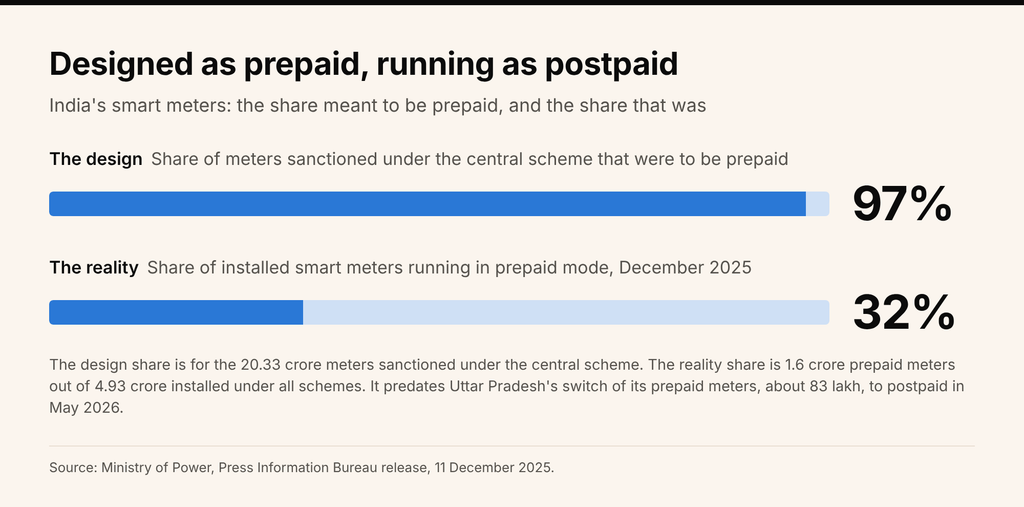
In August 2021 the Centre notified that consumers, other than farmers, “shall be supplied electricity with smart meters working in prepayment mode”. [2] Its distribution scheme then sanctioned 20.33 crore smart meters, 97 per cent of them prepaid. [3] [4] About ₹1.31 lakh crore of sanctioned work was for metering. [4] In most states the central grant was 15 per cent of the meter cost, capped at ₹900 a meter. [5]
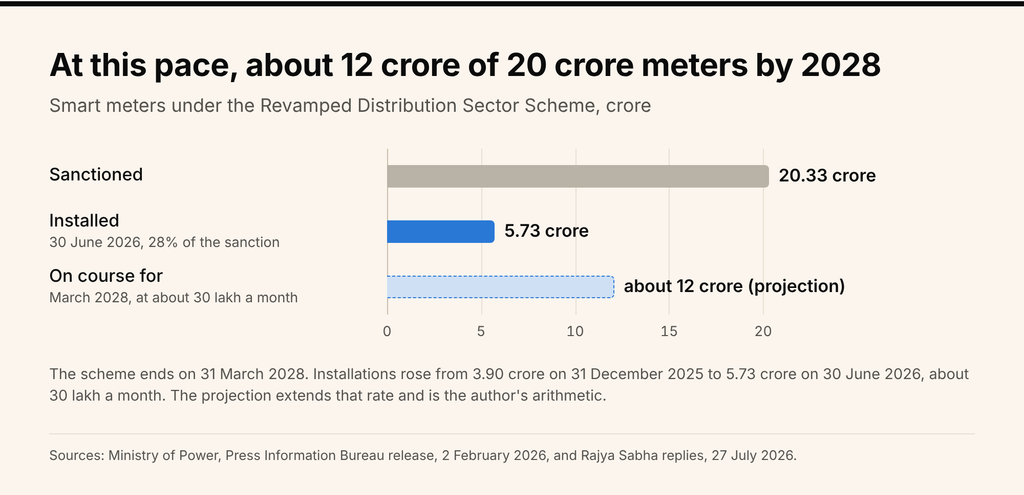
The pace tells part of the story. Installations under the scheme stood at 3.90 crore on 31 December 2025 [6] and 5.73 crore on 30 June 2026, or 28 per cent of the sanction. [4] That is roughly 30 lakh a month. At that rate, by my arithmetic, about 12 crore will be in place when the scheme ends on 31 March 2028.
The mode tells the rest. In December 2025 the ministry reported 4.93 crore smart meters installed across all schemes, of which 1.6 crore were running in prepaid mode. [3] A programme designed as 97 per cent prepaid was operating at about a third.
The retreat
| State | What it did | Its own numbers |
|---|---|---|
| Uttar Pradesh | Switched its prepaid meters to postpaid in May 2026; about 83 lakh, by the state consumer council’s count [7] | Losses rose from 16.39% to 19.54% in FY25 [8] |
| West Bengal | Suspended home installations in June 2025 and moved to quarterly bills [9] | 7 lakh of 2.10 crore sanctioned meters installed by June 2026 [4] |
| Maharashtra | Halted the household rollout in June 2024 [10], then restarted with postpaid meters [11] | The rollout had been planned for 2.16 crore consumers [10] |
| Gujarat | A utility paused installation in Vadodara in May 2024 [12]; the state added check meters [13] | 52 lakh of 1.68 crore sanctioned meters installed by June 2026 [4] |
| Bihar | Kept prepaid, with about 92 lakh meters [14] | Losses fell from 19.94% to 15.5% in FY25 [15] |
In April 2026 the power minister told the Lok Sabha that prepaid meters were optional. [16]
One instrument, unlike states
The mandate treated these states as the same problem, and they were not.
Gujarat had the least to gain. Its state utilities lost 8.25 per cent of their power in FY25, and one of them lost 4.26 per cent. [17] Maharashtra’s unpaid bills sat mostly on farms: figures reported in early 2021 showed farm arrears of ₹37,236 crore against ₹3,380 crore for homes. [18] Farm connections were exempt from the prepaid mandate [2], so the instrument was aimed at the consumers who owed least.
In Uttar Pradesh the failure was execution. According to a report of the state regulator’s April 2026 order, supply was restored within two hours in 77 per cent of cases against a 95 per cent standard. The regulator ordered about ₹200 crore refunded to more than five lakh consumers who had been charged ₹6,016 for meters bought at ₹2,500 to ₹2,630. A technical committee’s preliminary report found the meters working within prescribed limits. [19] The device was not the problem.
The state that wrote its own reform
Bihar has about 92 lakh prepaid smart meters, nearly 70 per cent of the national total. [14] I should declare an interest: I led a smart metering deployment for 2.6 million consumers in the state.
| Bihar | Figure |
|---|---|
| Prepaid smart meters | About 92 lakh [14] |
| Smart meters installed under the central scheme, June 2026 | About 23 lakh [4] |
| Losses in FY2004-05 | 59.15% [15] |
| Losses in FY25 | 15.5% [15] |
| Collections, FY24 to FY25 | ₹15,109 crore to ₹17,114 crore [15] |
| Collections, FY26 | ₹19,035 crore [20] |
| Sanctioned for free units, 2025-26 | ₹3,797 crore [21] |
| Smart prepaid meter rent claimed for FY27 | About ₹1,732 crore [22] [23] |
What set Bihar apart was not determination, because Uttar Pradesh was determined. It was not capacity, because Gujarat has more. It was authorship.
Bihar’s utilities began prepaid metering in Patna and a few other towns in 2013-14, years before any central mandate. They later set out to take it to 1.48 crore rural consumers under a state plan with an outlay of ₹15,074 crore, most of it private capital. [24] The official figures show the result. By June 2026 only about 23 lakh of the state’s smart meters had been installed under the central scheme. [4] The instrument also fitted the state, where 92 per cent of consumers are domestic. [24]
Bihar also wrote its own rules. Its utilities disconnect only between 10am and 2pm on working days and charge nothing for reconnection. [24] When the recharge app failed in late October 2024, they suspended disconnections for the urban consumers affected. [25] A 2023 survey of six states found the highest uptake of the smart meter app in Bihar, at 80 per cent. [26]
None of this prevented a backlash. In August 2024 villages in Bhagalpur and Darbhanga had their supply cut for hours after protesting installation. [27] The opposition held statewide protests that October [28], and the assembly was adjourned over the issue in November. [29] But the state did not abandon the meter. From 1 August 2025 it gave every household 125 free units a month. [21] Officials said about 1.67 crore of its 1.86 crore domestic consumers use no more than that on average. [30]
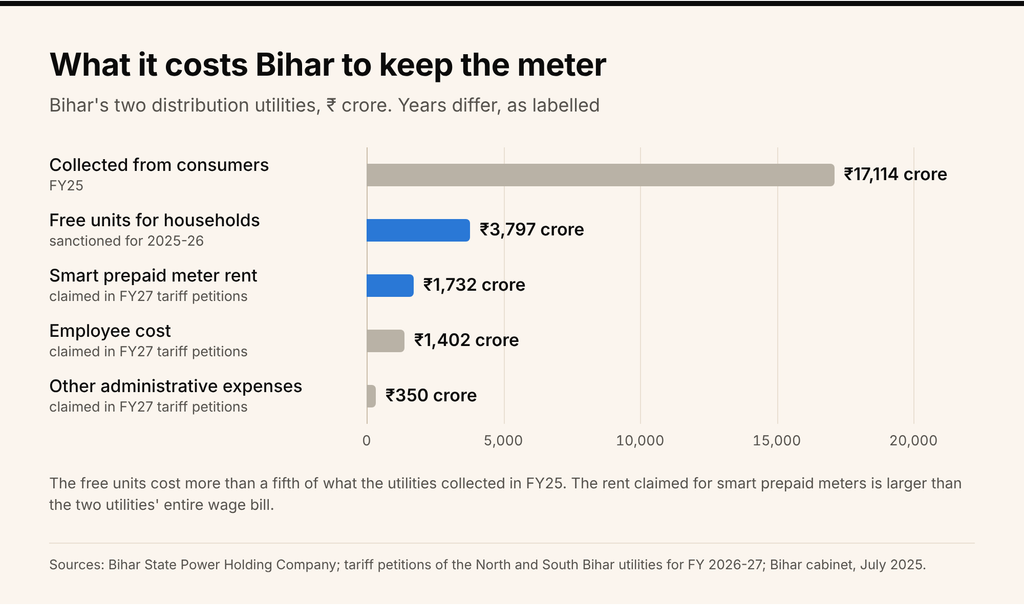
The price is visible. The ₹3,797 crore sanctioned for free units in 2025-26 [21] is more than a fifth of what the two utilities collected in FY25. [15] The rent they have claimed for smart prepaid meters in FY27, about ₹1,732 crore, is larger than their entire wage bill of about ₹1,402 crore. [22] [23] One can dislike that bargain. But it was Bihar’s bargain, made in its own budget by the government that would answer for it.
A reform a state did not choose is a reform it will not defend in an election year.
What this argument is not
It is not a claim that states know best. State discretion built these losses. A study of Uttar Pradesh found that unbilled power rose by about three percentage points just before state elections, and that 29 per cent of all power sent out between 1970 and 2010 was never billed. [31]
It is not a case against private ownership either. Private utilities lost 10.05 per cent of their power in FY25, against 15.40 per cent for state-owned ones. [17] Odisha’s privatised companies cut losses by 11 to 16 points between FY20 and FY25. [32] Odisha still stood at 17.81 per cent in FY25 [17], behind publicly owned Bihar. Improvement is slow under any owner.
What the Centre does well
There is a central intervention that worked, and it explains the difference. On 3 June 2022 utilities owed generators ₹1,39,947 crore in legacy dues. The late payment rules notified that day set one outcome, pay on time, and attached one sanction, restricted access to power. By 27 March 2026 the dues had fallen to ₹3,330 crore, a drop of about 98 per cent. [33]
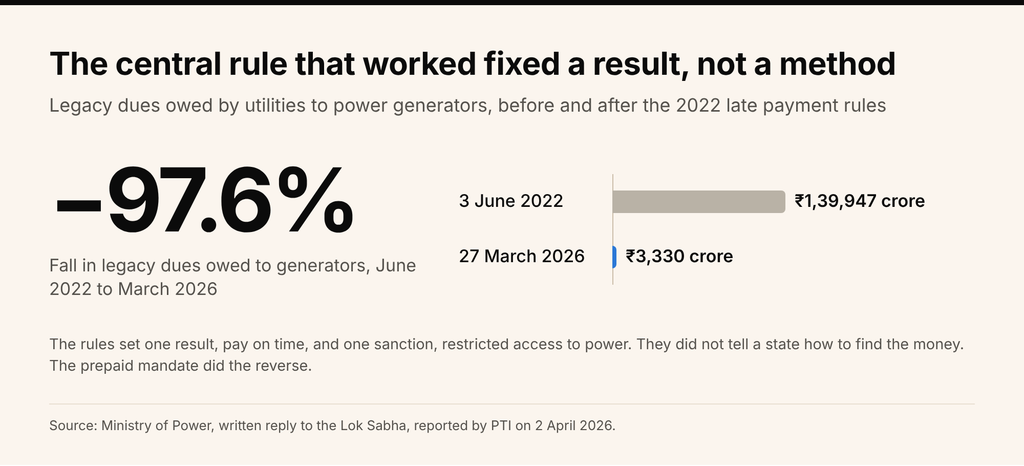
That rule did not tell a state how to find the money. It fixed the result and left the method alone. The metering mandate did the reverse: it fixed the method and hoped for the result.
Federalism by instruction
I have argued before that Indian federalism is moving from cooperation to competition [34], and that states work best as laboratories. [35] The power sector shows a third mode that fits neither description. The Centre saw one laboratory’s result and ordered it everywhere, before anyone had established why it worked. States complied on paper and defected in practice.
This was predictable. The state government owns the utility and appoints the regulator that oversees it. An instruction from Delhi passes through both before it reaches a consumer.
The privatisation ultimatum repeats the design. Delhi selects the instrument, and the state carries the strike, the tariff and the election. Uttar Pradesh shelved a privatisation plan in October 2020 after its power employees went on strike. [36] The two utilities it now proposes to sell cover 42 of its 75 districts. [37]
The stakes are large. State-owned utilities carried debt of ₹7.42 lakh crore in March 2024, and the power sector accounted for 47 per cent of state government guarantees in 2023-24. [38]
Four changes
Condition money on outcomes, not instruments. Central funds should follow losses reduced, subsidies paid on time and meters that communicate. Prepaid or postpaid, public or private, is the state’s decision.
Publish what the laboratories find. Bihar says its meters have generated nearly 10 billion data points. [14] I could find almost none of what they show about households in the public domain. A state cannot learn from a result it cannot see.
Keep the budget constraint hard. The Centre’s legitimate power is refusing to pay for failure. A state that gives power away should carry the cost in its budget, as Bihar now does, and not in its utility’s unpaid bills.
Let states choose their route to the same target. Gujarat does not need Bihar’s instrument, and Maharashtra’s problem sits on its farms.
The test
This argument can be checked. If states pushed into a sale or a listing they did not design keep it through an election, I am wrong. Bihar offers the second test. Its collections rose 12 per cent to ₹19,035 crore in FY26, the first year of free units. [20] If that reverses once the cost of free power is counted in full, authorship was not enough. Both will be visible by the time the scheme ends in 2028.
The Centre can fund a meter, a sale or a listing. It cannot stand for election in Patna or Lucknow. Reform belongs to the government that must.
References
- The Tribune, “Power ministry warns 6 states on Discom reform, demands privatisation or loss reduction”, 2 November 2025. Link
- Business Today, “Govt notifies timelines for replacing existing electricity meters with smart prepaid meters”, 19 August 2021. Link
- Ministry of Power, “Nationwide Push for Smart Prepaid Meters”, Press Information Bureau, 11 December 2025. Link
- Ministry of Power, replies to Rajya Sabha unstarred questions on the distribution scheme, 27 July 2026. Link
- Powerline, “RDSS Update: Initiatives to revamp distribution”, 26 June 2024. Link
- Ministry of Power, “Progress on Smart Meter Installation under RDSS”, Press Information Bureau, 2 February 2026. Link
- Upstox News, “UP govt rolls back smart prepaid electricity meter system”, 8 May 2026. Link
- SolarQuarter, “Uttar Pradesh power discoms show gains in FY25 ratings but AT&C losses remain a challenge”, 31 January 2026. Link
- ThePrint/PTI, “Smart meters will be treated as normal ones, consumers to pay bills every 3 months: Bengal govt”, 11 June 2025. Link
- Lokmat Times, “Maharashtra Government Halts Smart Meter Rollout for Residential Use”, 15 June 2024. Link
- Nagpur Today, “MSEDCL rolls out free smart TOD meters, scraps prepaid billing plan”, 3 February 2025. Link
- Gujarat Samachar, “MGVCL halts smart meter rollout amid public backlash”, 19 May 2024. Link
- Gujarat Samachar, “Gujarat government takes cognizance of public outcry, announces dual meter system”, 21 May 2024. Link
- Patna Press, “Bihar Leads India in Smart Meter Rollout, Accounts for 70% of Prepaid Installations: Energy Secretary”, 7 August 2026. Link
- OneIndia, “Bihar DISCOMs of Energy Deptt Achieve Historic Reduction in AT&C Loss to 15.50%”, April 2025. Link
- All India Radio News, “Union Power Minister says prepaid smart meters not mandatory for consumers”, 2 April 2026. Link
- T&D India, report on the 14th Integrated Rating and Ranking of Power Distribution Utilities, 27 January 2026. Link
- Hindustan Times (Mumbai), “MSEDCL in losses”, 4 February 2021. Link
- Swarajya, “UP’s Smart Meter Climbdown”, 20 May 2026. Link
- Patna Press, “Bihar DISCOMs Hit Record Rs 19,035 Crore Revenue in FY26”, 1 April 2026. Link
- All India Radio News, “Bihar cabinet approves 125 units of free electricity for domestic consumers”, 18 July 2025. Link
- North Bihar Power Distribution Company, tariff formats for FY 2026-27, filed with the Bihar Electricity Regulatory Commission, November 2025. Link
- South Bihar Power Distribution Company, tariff formats for FY 2026-27, filed with the Bihar Electricity Regulatory Commission, November 2025. Link
- Government of Bihar, “Smart Metering with Prepaid Functionality: Challenges and Success Story of Bihar”, Department of Economic Affairs best-practice portal. Link
- Bihar State Power Holding Company, post on X about the app outage from 28 October 2024. Link
- Council on Energy, Environment and Water, “60% of Surveyed Smart Meter Consumers are Satisfied With the Technology”, 20 March 2023. Link
- NewsClick, “Bihar: Protests Spread Against ‘Forcible’ Installation of Smart Prepaid Meters in Rural Areas”, August 2024. Link
- The News Minute, “RJD launches statewide protest against smart meters”, 1 October 2024. Link
- Deccan Herald/PTI, “On last day of winter session, Bihar assembly rocked over pre-paid meters issue”, 29 November 2024. Link
- OneIndia, “Bihar’s 60 Lakh Smart Prepaid Meter Users Get Breather”, 21 July 2025. Link
- Brian Min and Miriam Golden, “Electoral cycles in electricity losses in India”, Energy Policy 65 (2014), as summarised by the University of Michigan. Link
- Down To Earth, report on SBICAPS, “DISCOM Privatisation: A Path to Achieve State Fiscal Targets”, 20 May 2026. Link
- Outlook Business/PTI, “Discoms’ Legacy Dues Reduce To ₹3,300 Cr From ₹1.39 Lakh Cr In 4 Years: Power Min”, 2 April 2026. Link
- Anil S Mehta, “India’s Evolving Federalism: How Competitive Federalism Is Shaping Economic Growth”, 2024. Link
- Anil S Mehta, “Decentralisation and Competitive Federalism: A Pathway to Economic Resurgence”, 2025. Link
- ANI, “UP power employees call off stir against privatisation of Poorvanchal Distribution Company after govt assurances”, 6 October 2020. Link
- The Week, “Uttar Pradesh power employees begin stir against privatisation of two key regions”, 17 April 2025. Link
- PRS Legislative Research, “State of State Finances”, October 2025. Link