Environment
Finance
Policy
Technology
Air pollution, air quality monitoring, airshed management, Central Pollution Control Board, clean air policy, climate and health, coal power, Delhi air pollution, environmental governance, Environmental Policy, Federalism, FGD, household solid fuel, India, India policy, Indo-Gangetic Plain, Lancet Countdown, National Clean Air Programme, NCAP, PM10, PM2.5, public health, secondary particulate matter, sulphur dioxide, Swachh Vayu Sarvekshan, waste-to-energy
AnilMehta
India’s Air Crisis: More Politics, Less Policy
New Delhi treats toxic air as a city problem to be managed with water trucks and flattering data. It is an emergency across the whole Gangetic plain, and India’s institutions are not built to see it.
Every winter, the world’s attention turns to Delhi and finds the same scene: a grey city, masked commuters and a government spraying water into the air. This year the capital’s answer included misting machines in Dwarka, and Rekha Gupta, Delhi’s chief minister, declared watering the only solution. The city did not record a single “good” air-quality day in 2025.[1]
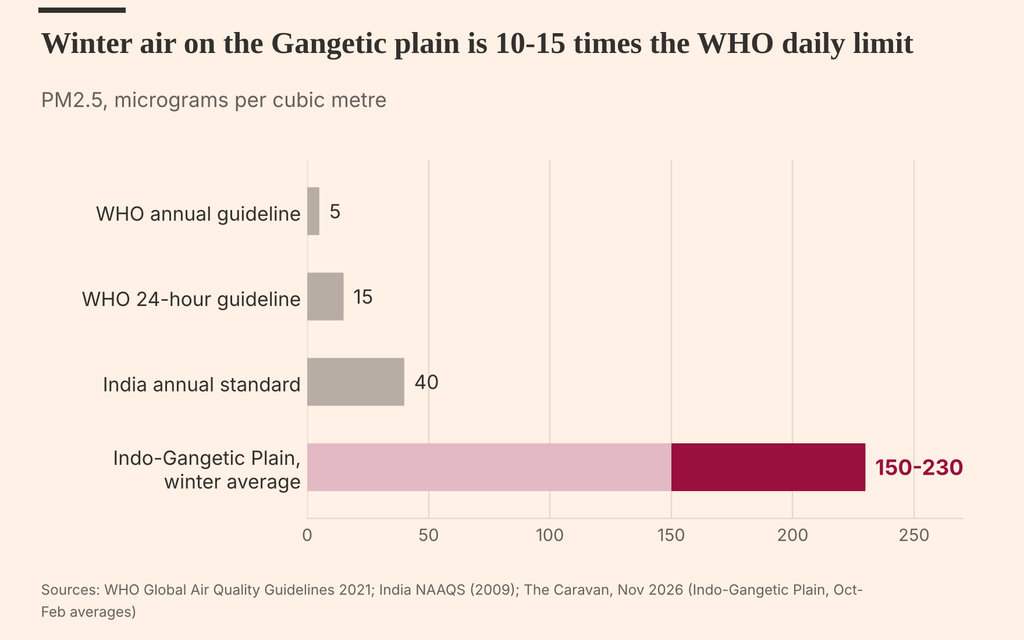
Delhi is not the problem, or not the whole of it. It sits in the Indo-Gangetic Plain, a single basin of air that does not stop at state borders. Between October and February, average concentrations of PM2.5, the finest and most dangerous particles, reach 150 to 230 micrograms per cubic metre across the plain.[1] The World Health Organization recommends an annual average of five, and no more than 15 on any day, on at most four days a year.[2] Last winter Hapur, Noida and Ghaziabad often recorded worse air than Delhi. Muzaffarnagar, Lucknow, Patna and Howrah consistently ranked among the most polluted cities. Gorakhpur, Barnala, Muzaffarpur and Loni crossed an air-quality index of 500, the “hazardous” band. Those are only the places with instruments.[1]
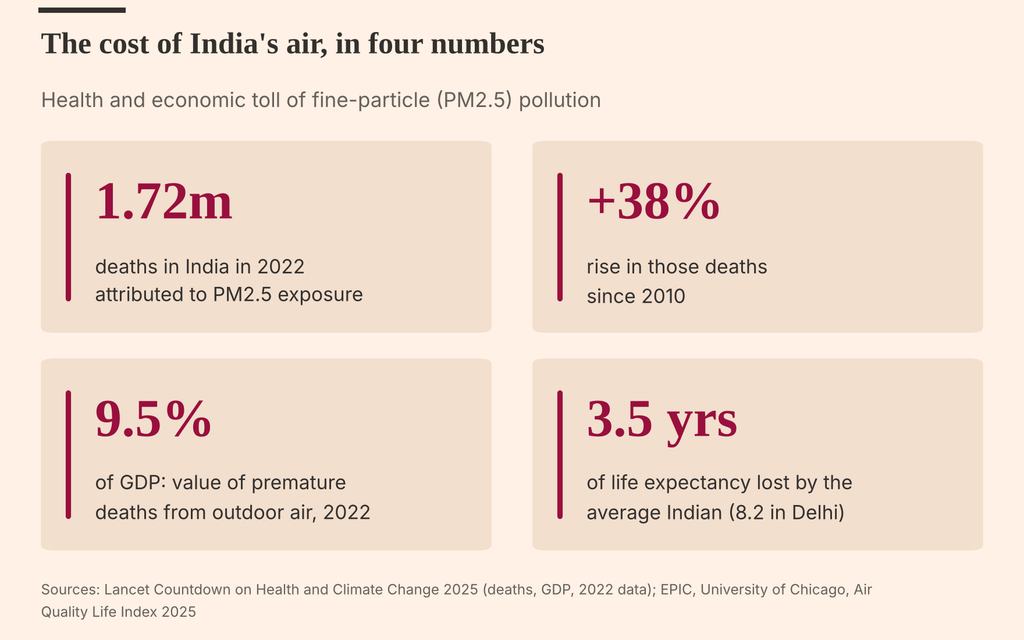
The human cost is no longer in doubt. The 2025 Lancet Countdown attributed 1.72 million Indian deaths in 2022 to PM2.5, almost 40 per cent more than in 2010. Nearly 400,000 of them were linked to coal, mostly burnt in power stations. The Lancet has calculated that premature deaths from outdoor air pollution amounted to 9.5 per cent of national GDP in 2022.[3] A University of Chicago study finds that dirty air shortens the average Indian life by more than three years, and by more than eight in the National Capital Region.[4]
Yet not one death in India’s official records has ever been directly attributed to air pollution.[1] The government says there is no conclusive data establishing a “direct, exclusive correlation” with mortality.[5] Epidemiology cannot meet that test for any risk with many causes, including tobacco. The demand is a way of avoiding a conclusion, not a standard of evidence.
The deeper failure is in measurement, and it fails in three ways.
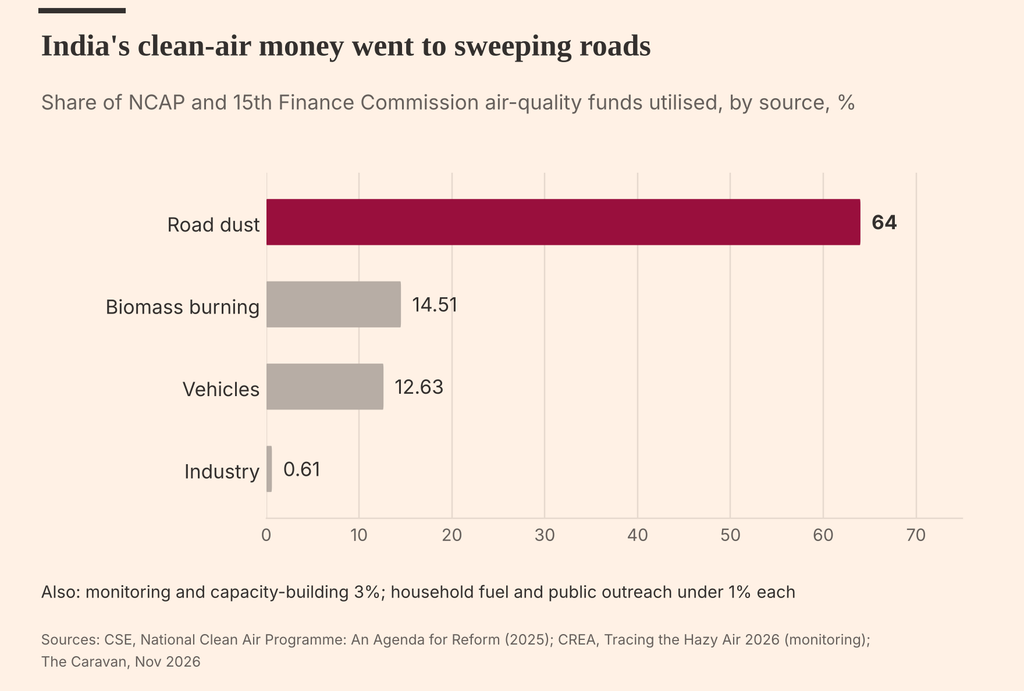
The wrong pollutant. The National Clean Air Programme (NCAP), launched in 2019, named both PM2.5 and PM10 as priorities. In 2022 its target became a 40 per cent cut in PM10, or meeting national standards, by 2026.[6] PM10 is largely dust from roads and construction. PM2.5 comes from combustion and lodges deep in the lungs and bloodstream.[1] Spending followed the metric. More than two-thirds of NCAP money went to managing road dust. Monitoring and capacity-building got 3 per cent. Industry, household fuel and public outreach got less than 1 per cent each.[7][8] Even on its chosen measure, after seven years and ₹12,000 crore, nine in ten of the cities it targets still exceed the national PM10 standard.[1] In 2025, 190 of the 229 cities monitored across India did too.[8] Swachh Vayu Sarvekshan, the government’s air-quality ranking, scores cities on actions taken and changes in PM10. It leaves out the Central Pollution Control Board’s own air-quality readings, stubble burning and the precursor gases that form particles. Researchers at the Indian Institute of Science found that the municipal bodies doing the work also assess it.[9] A city can report progress while its air grows no safer.
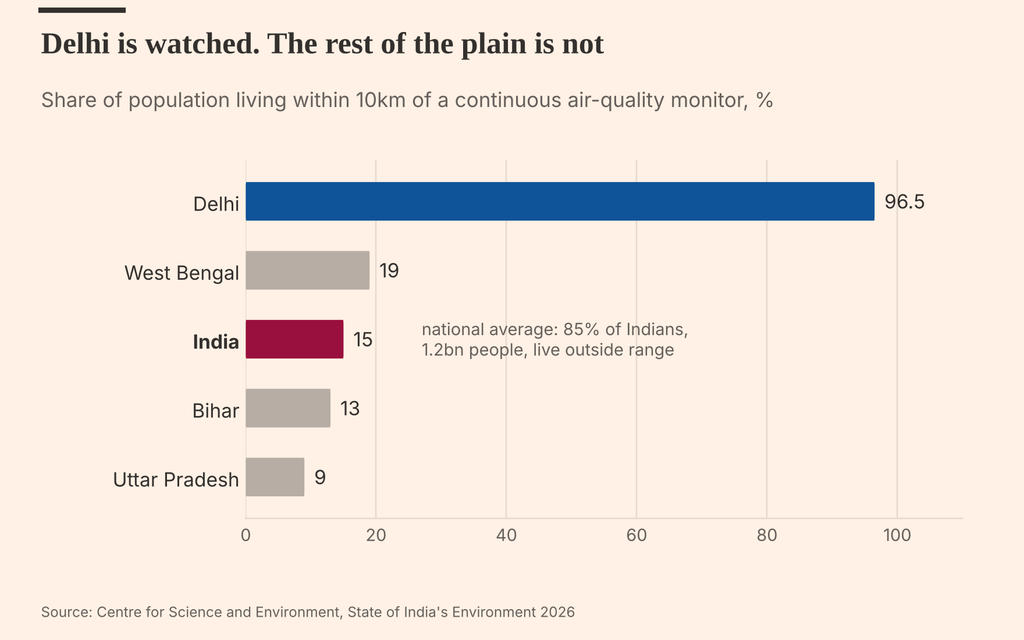
The wrong places. Of India’s 7,933 cities and towns, 603 had official monitors as of March. Only 15 per cent of Indians live within 10km of a continuously operating station. In Bihar the share is 13 per cent, in Uttar Pradesh 9 per cent, and West Bengal monitors areas holding 19 per cent of its people. Hooghly and Murshidabad, two of its most densely populated districts, have no real-time monitor at all.[10] The entire rural network, as of 2023, was 26 manual stations in 26 villages. In Delhi, Lutyens’ zone and Civil Lines have overlapping coverage. Bawana, Mundka and other industrial districts on the edges, which host waste incinerators and freight corridors, have little or none. Sprinklers were reportedly placed beside monitoring stations. Varanasi reports a 74 per cent fall in PM10, one of the best results among NCAP cities. It has five manual and four real-time monitors where at least 23 are needed, and it has not completed the mandatory study of where its pollution comes from.[1] Where the instruments sit shows where political attention goes.
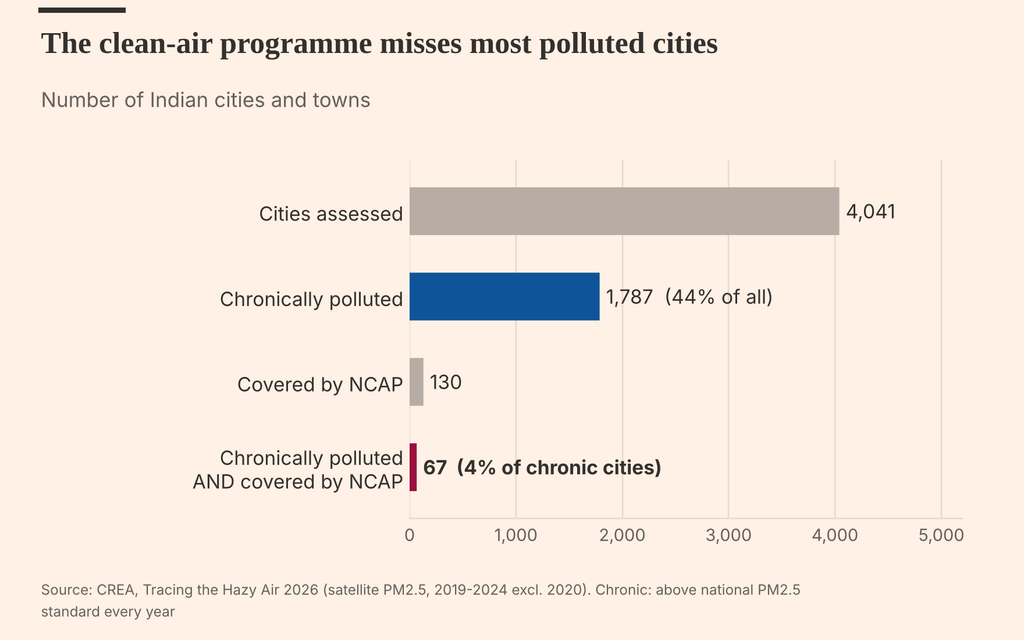
The wrong scale. A 2021 study in a journal of the American Chemical Society found that 62 per cent of India’s PM2.5 is secondary. It forms in the atmosphere when gases from many sources react.[11] No municipality can regulate a chemical reaction spread across three states. The weather makes it worse. In winter the atmosphere’s capacity to disperse pollution can fall fivefold.[11][1] Aerosols dim sunlight, which damps the turbulence that would otherwise clear them, and surface winds over India are now about 40 per cent as strong as in 1980.[1] Yet NCAP covers fewer than 2 per cent of India’s cities and towns.[1] Of the 44 per cent of cities with chronic pollution, it reaches 4 per cent.[8]
What should India burn less of? The answer is less comfortable than the capital’s debate allows. The same 2021 study found household burning of wood, dung and crop residue to be the largest contributor to ambient PM2.5 on the plain.[11] Farm-fire smoke, the subject of every Delhi winter, contributed about 8 per cent in 2016.[11][1] Clean stoves have been promoted since before the 1990s without wide uptake, because dung and wood remain cheaper than refilling a gas cylinder. That is a question of household economics, and handing out gas connections does not answer it. Brick kilns produce another 15 per cent of national PM2.5.[1]
Meanwhile the state has been relaxing rules on the sources that create secondary particles. India is the world’s largest emitter of sulphur dioxide. In July 2025 most coal-fired power plants were exempted from installing equipment to cut it.[12] Waste-to-energy incinerators were exempted from prior environmental clearance in the autumn of 2025, and moved into the CPCB’s least-polluting category.[13] Delhi’s Okhla plant can burn 711,750 tonnes of municipal waste a year and has been fined by both the National Green Tribunal and the city’s pollution regulator. A second Jindal incinerator was cleared at Bawana.[1] Water is sprayed on roads while emission rules for chimneys are loosened.
The burden is not shared evenly. Daily-wage workers breathe the air outdoors and lose earnings whenever emergency curbs halt construction. In the coalfields of Jharia, fires that have burnt for over a century emit more than 9,000kg of PM10 a day. Occupational doctors in the mining belt say daily air sampling to control workers’ exposure is virtually unheard of.[1] Health damage is recorded at big city hospitals, far from where much of it begins. Even so, six Delhi hospitals logged more than 200,000 cases of acute respiratory illness between 2022 and 2024.[14] The share of Indians breathing air within national limits fell from over 60 per cent in 1998 to 28.4 per cent in 2020.[1]
What would a serious policy look like? Five changes would do more than any number of smog towers or the ₹3.21 crore spent on cloud seeding that produced no significant rain.[1]
- Measure emissions, not only readings. Concentrations depend on the weather; emissions are what policy controls. As the analyst Sunil Dahiya told The Caravan, judging progress by ambient readings is like judging a diet only by the scale.[1] India needs public, sector-by-sector caps on tonnes emitted, with binding interim milestones.
- Build an authority the size of the problem. The plain needs a statutory body that can set and enforce one plan across states and seasons, year round, with clear accountability.
- Fix the instruments. Audit every station, extend monitoring to rural districts and industrial belts, and end the practice of agencies grading their own work.
- Update the standards. India’s ambient air standards date from 2009, and a committee set up in 2020 to revise them has not finished.[1] PM2.5, not dust, should be the headline target.
- Stop exempting the sources that matter, and count the dead. That means restoring the sulphur controls on coal plants and the clearance requirement for incinerators, and treating clean household fuel as core energy policy. It also means recording deaths attributable to air pollution and building air quality into the tuberculosis programme.
Los Angeles, London and Beijing all lived with chronic smog, and all began to escape it by measuring honestly and for a long time. In southern California, researchers tracked about 11,000 children from the 1990s to 2015 and kept going as the air improved, which let policy be judged by results.[15] India has the science. What it lacks is the willingness to measure what it would rather not see.
References
- The Caravan, “Toxi-cities” (reportage), November 2026. Covers the article’s own field reporting and interviews (Dwarka, Ballia, Okhla, Jharia, Varanasi, Sunil Dahiya), plus figures it cites without a source I could trace: the IGP winter range, the city rankings, 117 cities and ₹12,000 crore, the 2023 rural network, IndiaSpend’s 2025 Delhi monitoring analysis, brick kilns at 15 per cent, Jharia emissions, the 1998–2020 share, the cloud-seeding cost, and the 2009 standards and 2020 committee.
- World Health Organization, WHO Global Air Quality Guidelines, 2021 (PM2.5: 5 µg/m³ annual; 15 µg/m³ 24-hour, 99th percentile, i.e. 3–4 exceedance days a year).
- Lancet Countdown on Health and Climate Change, 2025 Global Report and India Data Sheet, 29 October 2025.
- Energy Policy Institute at the University of Chicago (EPIC), Air Quality Life Index 2025 Annual Update, August 2025. https://aqli.epic.uchicago.edu
- Ministry of Environment, Forest and Climate Change (MoEFCC), Rajya Sabha Unstarred Question No. 382, answered 28 November 2024. https://rsdebate.nic.in/bitstream/123456789/753147/1/PQ_266_28112024_U382_p178_p179.pdf
- MoEFCC, Rajya Sabha Unstarred Question No. 369, answered 25 July 2024 (NCAP targets and revision). https://rsdebate.nic.in/bitstream/123456789/749611/1/PQ_265_25072024_U369_p243_p246.pdf
- Centre for Science and Environment (CSE), National Clean Air Programme: An Agenda for Reform, July 2025.
- Centre for Research on Energy and Clean Air (CREA), Tracing the Hazy Air 2026: Progress Report on NCAP and press release, 9 January 2026. https://energyandcleanair.org/publication/2026-progress-report-on-national-clean-air-programme/
- Indian Institute of Science, Sustainable Transportation Lab (Prof. Ashish Verma), technical review of Swachh Vayu Sarvekshan methodology, 2026, as reported in Deccan Herald. https://www.deccanherald.com/india/centres-air-quality-survey-methodology-flawed-says-iisc-study-4180459
- CSE and Down To Earth, State of India’s Environment 2026, February 2026, and CSE factsheet. https://www.cseindia.org/content/downloadreports/12879
- “Air Pollution Over India: Causal Factors for the High Pollution with Implications for Mitigation,” ACS Earth and Space Chemistry 5, no. 12 (2021): 3297–3312. https://pubs.acs.org/doi/abs/10.1021/acsearthspacechem.1c00170
- MoEFCC, notification amending SO₂ emission standards for thermal power plants, 11 July 2025; CREA, Exempted but Emitting: The Largest SO₂ Sources around Delhi NCR, 13 July 2026. https://energyandcleanair.org/wp/wp-content/uploads/2026/07/CREA_Exempted-but-emitting_-The-largest-SO2-sources-around-Delhi-NCR-continue-operating-without-control-technology.pdf
- MoEFCC, draft notification S.O. 4531(E), 3 October 2025 (exempting common municipal solid-waste facilities, including incinerators, from prior environmental clearance); CPCB, Revised Classification of Industrial Sectors, January 2025 (Blue category).
- Ministry of Health and Family Welfare, Rajya Sabha Question No. 274, answered 2 December 2025 (ARI data, six central hospitals in Delhi).
- Beth Gardiner, Choked: Life and Breath in the Age of Air Pollution (University of Chicago Press, 2019); University of Southern California, Children’s Health Study.