Economics
Environment
Finance
Policy
agroforestry, carrying capacity, Chamoli flood, Char Dham, chir pine, Climate Resilience, ecosystem services, forest economy, ghost villages, green bonus, hill agriculture, hill development, Himalaya, Himalayan disasters, Himalayan tourism, India policy, Joshimath, Kedarnath, land subsidence, landslides, mountain economy, NITI Aayog, oak restoration, out-migration, Palayan Aayog, public finance, regional inequality, rural depopulation, SDG India Index, spatial planning, spring rejuvenation, state budget, Sustainable Development, Uttarakhand, Van Panchayat
AnilMehta
Uttarakhand is India’s sustainability champion. Its mountains are emptying anyway.
The state’s number-one ranking masks a spatial collapse — and a budget that funds the very growth destabilising the Himalaya
In July 2024, NITI Aayog crowned Uttarakhand the joint-best performing state in its Sustainable Development Goals India Index, with a score of 79, level with Kerala and comfortably above the national average of 71 [1]. It was a genuine achievement, and the state government has not stopped repeating it. Yet drive two hours up almost any valley road from Dehradun and you pass houses with the doors padlocked and no one under sixty in the lanes. A state can top a sustainability league table and be quietly emptying out at the same time. The ranking is a state average, and averages are where mountain states go to hide.
Uttarakhand has thirteen districts: eleven in the hills, two in the plains. Almost everything that the index measures as progress — income, services, urbanisation — is concentrated in the two plains districts of Haridwar and Udham Singh Nagar and the valley capital of Dehradun. Between the 2001 and 2011 censuses, the hill districts grew at 0.7 per cent against 2.8 per cent in the plains; Almora and Pauri Garhwal lost population outright [2]. Per-capita income in the remotest hill districts now runs at roughly a quarter of plains levels [3]. The state was carved out of Uttar Pradesh in 2000 precisely to develop the hills. On that founding promise it has structurally failed.
The numbers behind the padlocked doors are official. The state’s own Rural Development and Migration Commission has documented around 384,000 semi-permanent and nearly 119,000 permanent out-migrants from several thousand village councils [4]. The 2011 census recorded 1,055 fully uninhabited villages and another 405 with fewer than ten residents; by 2018 the Commission counted a further 734 emptied since 2011 [5]. The migration is male-selective, leaving behind the old and the women who hold the terraces together. Farming, once the hill economy, now contributes about a tenth of state output and is growing at 1.6 per cent a year [6]. “Ghost village” has become an administrative category.
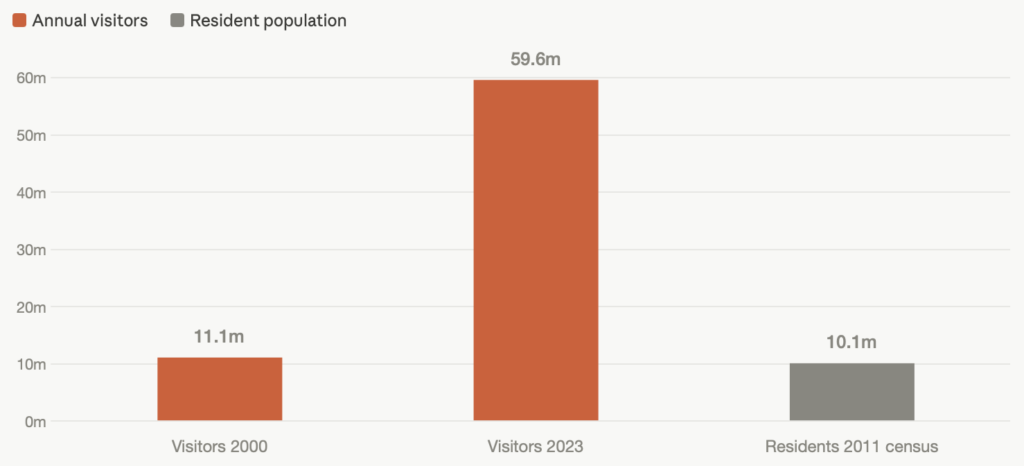
Figure: Annual tourist/pilgrim footfall vs resident population, millions. Visitors in 2023 were roughly six times the resident population. Sources: Uttarakhand tourism figures via India Water Portal (ref 7); 2011 Census (ref 2).
The second crisis is that the mountains themselves are breaking. The Geological Survey of India assesses roughly 72 per cent of the state — some 39,000 sq km — as landslide-prone [7]. In the winter of 2022-23 the town of Joshimath sank 5.4 cm in thirteen days and cracked more than 860 buildings, an event the country’s space agency measured from orbit [8]. Kedarnath in 2013, the Chamoli glacial flood of 2021, the Silkyara tunnel collapse of 2023, the Dharali cloudburst of 2025: this is no longer a tail risk but the operating environment. Over the same period, annual tourist and pilgrim footfall rose from 11m in 2000 to nearly 60m in 2023 — about six times the resident population — with no enforced limit on how many feet a fragile slope can carry [9].
These two crises are one crisis. The only economic engines that work in the hills — pilgrimage tourism, four-lane road-widening to the shrines, hydropower — are precisely the activities that destabilise the slopes, while the population that once maintained them departs. Growth and collapse have become the same process.
The state budget makes the contradiction legible. Uttarakhand is not poor or profligate: its 2026-27 budget is about Rs1.12tn, its debt around a quarter of state output, and it runs a revenue surplus [10][11]. The problem is allocation. The same budgets that set aside Rs125 crore for spring and river rejuvenation, Rs60 crore for climate mitigation and Rs20 crore for border-village development commit Rs2,502 crore to roads and bridges and over Rs1,000 crore to a single religious congregation [11][12]. A Migration Prevention Scheme exists, but at a scale that rounds to nothing. The money flows, overwhelmingly, to the side of the ledger that manufactures the disaster.
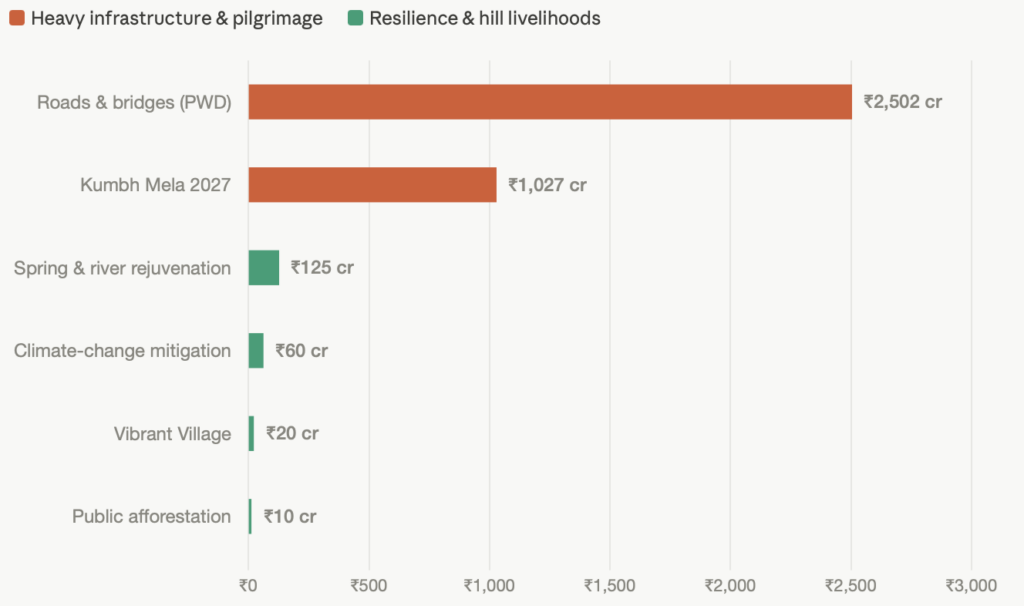
Figure – Selected Uttarakhand budget allocations, ₹ crore. Roads and Kumbh figures are from the 2026-27 budget; spring/river, climate, Vibrant Village and afforestation lines are from the 2025-26 budget. Sources: Government of Uttarakhand budget documents 2025-26 and 2026-27 (refs 11, 12).
What is missing is the one instrument that answers both problems at once. Forests cover about 71 per cent of Uttarakhand on paper — closer to 45 per cent by measured canopy — and the state has five times the national per-capita forest area [13]. It also possesses something no other Indian state does: more than 12,000 Van Panchayats, century-old, democratically elected village forest councils with reserved seats for women [13]. Agroforestry — walnut, apple and apricot interplanted with shade-grown medicinal and aromatic crops, and oak restored in place of the fire-prone, water-starving chir pine now spreading across the hills — simultaneously raises hill incomes, stabilises slopes, recharges springs and cuts forest fires [14]. It is the rare policy that pays a dividend to both the economy and the mountain. Yet there is no dedicated agroforestry-livelihood line in the budget; forests appear mainly as a compensation cost under afforestation rules, and the Van Panchayats receive no serious money at all.
The remedy is not more spending but a different unit of analysis. Uttarakhand must abandon the state average and govern at the level of the district and the slope: screen every road, tunnel and tourism project against geological and carrying-capacity risk, route hill livelihoods through agroforestry and the Van Panchayats it already has, and press its legitimate claim for ecosystem-service compensation — a “green bonus” — for the forests the rest of India free-rides upon. This is work the state cannot do with its own dashboards, and it is exactly the kind of capability it should be buying in.
A number-one ranking that cannot see its own emptying villages is not a measure of success. It is a measure of measurement failure. The Himalaya will not be saved by a league table.
References
- https://www.businesstoday.in/india/story/uttarakhand-becomes-the-top-performer-in-niti-aayogs-sdg-india-index-2023-24-436997-2024-07-12
- Mamgain, R.P., “Forced Out-Migration from Hill Regions… Evidence from Uttarakhand,” Indian Journal of Labour Economics (hill vs plains decadal growth; absolute decline in Almora and Pauri) — https://pmc.ncbi.nlm.nih.gov/articles/PMC7659421/
- Per-capita NDDP by district, Directorate of Economics & Statistics, Government of Uttarakhand, 2021-22 (compiled) — https://grokipedia.com/page/List_of_districts_of_Uttarakhand (secondary compilation; reconcile against the DES District Domestic Product tables before final publication)
- https://www.uttarakhandpalayanayog.com/pdf/Palayan%20Ayog%20Report_English.pdf
- https://www.newsclick.in/Mass-Migration-Uttarakhand-Ghost-Villages-Still-Huge-Problem
- https://prsindia.org/budgets/states/uttarakhand-budget-analysis-2025-26
- https://www.indiawaterportal.org/climate-change/disasters/cloudbursts-landslides-and-floods-why-uttarakhands-fragile-himalayas-are-breaking-under-pressure
- https://www.orfonline.org/research/lessons-from-joshimath-the-need-for-a-himalayan-development-model
- https://www.nature.com/articles/s41598-024-60276-3
- https://www.niti.gov.in/sites/default/files/2025-03/Macro-and-Fiscal-Landscape-of-the-State-of-Uttarakhand.pdf
- https://www.drishtiias.com/state-pcs-current-affairs/uttarakhand-budget-2026-27
- https://www.drishtiias.com/state-pcs-current-affairs/uttarakhand-budget-2025-26
- https://101reporters.com/article/environment/Forest_management_by_people_for_people_A_look_at_Van_Panchayats_of_Uttarakhand
- https://iucn.org/news/asia/201707/blog-restoring-forests-future-himalayan-mountain-communities